
A conversation with ecommerce practitioner Leo Nguyen on contested data, hallucinated policies, and why being readable is not the same as being chosen.
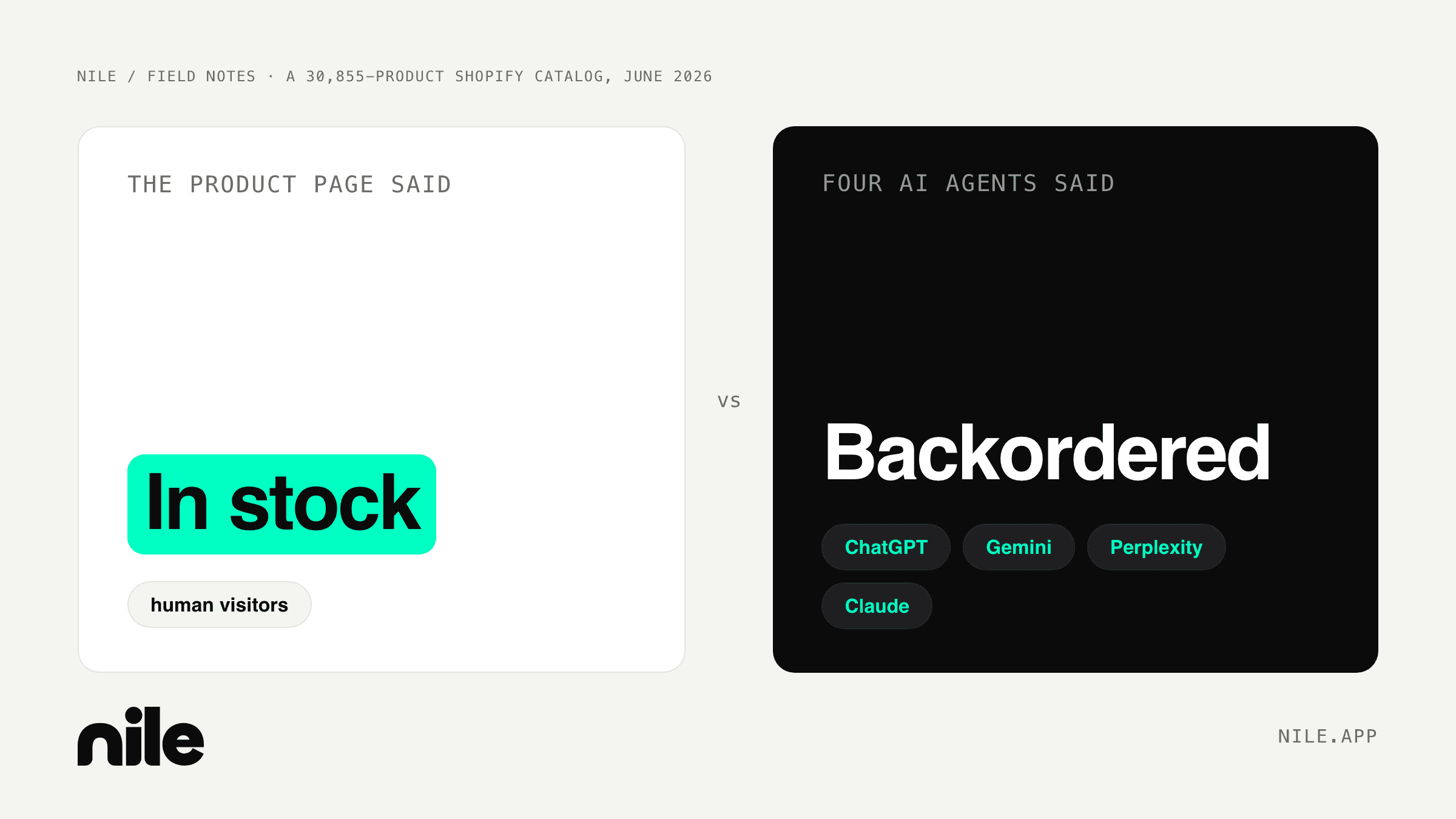
In June, a Home Elegance USA product page told shoppers an item was in stock. ChatGPT, Gemini, Perplexity, and Claude all said it was backordered. Nothing looked broken. The storefront template had hardcoded a backorder message into its HTML and let JavaScript paint the correct status over it for human visitors. People saw the right answer. Machines kept the wrong one.
Leo Nguyen found and fixed that failure. He is the founder of LUMA-E, an ecommerce infrastructure firm, with more than 50 projects behind him, concentrated on Shopify Plus and Magento 2, working with catalog-heavy brands (jewelry, knitwear, furniture, beauty, publishing) across the US, UK, EU, Australia, and Vietnam. We spoke with him about what AI shopping systems actually receive from merchant stores, and what he has learned watching four different agents read the same catalog.
This conversation has been edited for length and clarity. The Home Elegance case discussed below was a client-approved engagement conducted and documented by LUMA-E, not independent research.
Your clients are mostly established brands, not AI enthusiasts. Where are they on AI commerce adoption?
Almost none are true early adopters. A few are experimenting deliberately, but most are pragmatists who are already in it because Shopify flipped Agentic Storefronts to default, not because they had a strategy.
The interesting group isn't the people asking "how do I get into AI shopping." It's the ones already in it who don't know what the agent is saying about them.
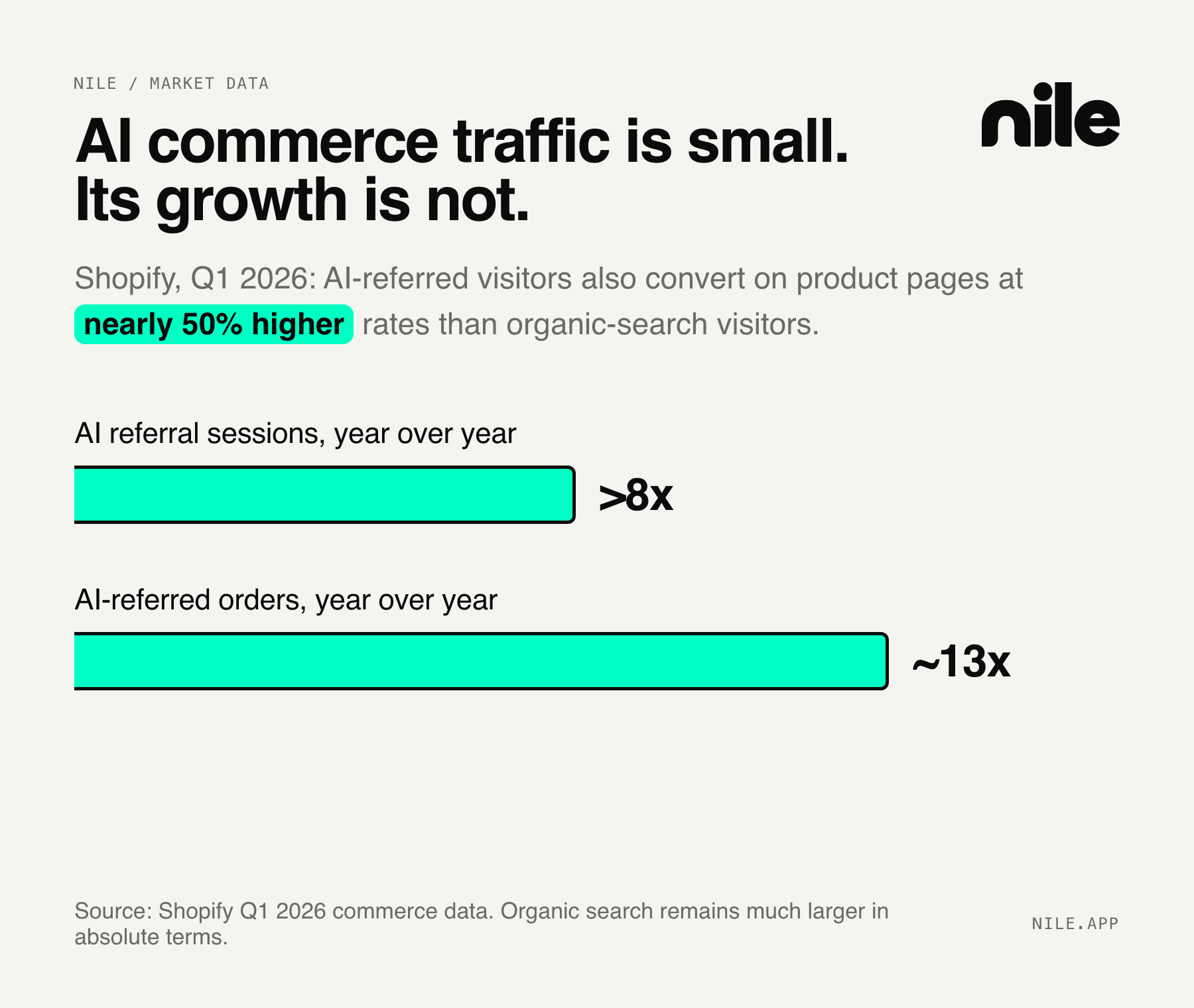
Editor's note: Shopify's Agentic Storefronts are active by default for eligible stores, exposing products to AI channels including ChatGPT and Microsoft Copilot, with Google AI Mode and Gemini in early access. The traffic is still small next to organic search, by Shopify's own account, but growing fast: AI-chatbot referral sessions grew more than 8x year over year in Q1 2026, AI-referred orders grew nearly 13x, and AI-referred visitors converted on product pages at nearly 50% higher rates than organic-search visitors.
A conversation with ecommerce practitioner Leo Nguyen on contested data, hallucinated policies, and why being readable is not the same as being chosen.
In June, a Home Elegance USA product page told shoppers an item was in stock. ChatGPT, Gemini, Perplexity, and Claude all said it was backordered. Nothing looked broken. The storefront template had hardcoded a backorder message into its HTML and let JavaScript paint the correct status over it for human visitors. People saw the right answer. Machines kept the wrong one.
Leo Nguyen found and fixed that failure. He is the founder of LUMA-E, an ecommerce infrastructure firm, with more than 50 projects behind him, concentrated on Shopify Plus and Magento 2, working with catalog-heavy brands (jewelry, knitwear, furniture, beauty, publishing) across the US, UK, EU, Australia, and Vietnam. We spoke with him about what AI shopping systems actually receive from merchant stores, and what he has learned watching four different agents read the same catalog.
This conversation has been edited for length and clarity. The Home Elegance case discussed below was a client-approved engagement conducted and documented by LUMA-E, not independent research.
Your clients are mostly established brands, not AI enthusiasts. Where are they on AI commerce adoption?
Almost none are true early adopters. A few are experimenting deliberately, but most are pragmatists who are already in it because Shopify flipped Agentic Storefronts to default, not because they had a strategy.
The interesting group isn't the people asking "how do I get into AI shopping." It's the ones already in it who don't know what the agent is saying about them.
Editor's note: Shopify's Agentic Storefronts are active by default for eligible stores, exposing products to AI channels including ChatGPT and Microsoft Copilot, with Google AI Mode and Gemini in early access. The traffic is still small next to organic search, by Shopify's own account, but growing fast: AI-chatbot referral sessions grew more than 8x year over year in Q1 2026, AI-referred orders grew nearly 13x, and AI-referred visitors converted on product pages at nearly 50% higher rates than organic-search visitors.
A conversation with ecommerce practitioner Leo Nguyen on contested data, hallucinated policies, and why being readable is not the same as being chosen.
In June, a Home Elegance USA product page told shoppers an item was in stock. ChatGPT, Gemini, Perplexity, and Claude all said it was backordered. Nothing looked broken. The storefront template had hardcoded a backorder message into its HTML and let JavaScript paint the correct status over it for human visitors. People saw the right answer. Machines kept the wrong one.
Leo Nguyen found and fixed that failure. He is the founder of LUMA-E, an ecommerce infrastructure firm, with more than 50 projects behind him, concentrated on Shopify Plus and Magento 2, working with catalog-heavy brands (jewelry, knitwear, furniture, beauty, publishing) across the US, UK, EU, Australia, and Vietnam. We spoke with him about what AI shopping systems actually receive from merchant stores, and what he has learned watching four different agents read the same catalog.
This conversation has been edited for length and clarity. The Home Elegance case discussed below was a client-approved engagement conducted and documented by LUMA-E, not independent research.
Your clients are mostly established brands, not AI enthusiasts. Where are they on AI commerce adoption?
Almost none are true early adopters. A few are experimenting deliberately, but most are pragmatists who are already in it because Shopify flipped Agentic Storefronts to default, not because they had a strategy.
The interesting group isn't the people asking "how do I get into AI shopping." It's the ones already in it who don't know what the agent is saying about them.
Editor's note: Shopify's Agentic Storefronts are active by default for eligible stores, exposing products to AI channels including ChatGPT and Microsoft Copilot, with Google AI Mode and Gemini in early access. The traffic is still small next to organic search, by Shopify's own account, but growing fast: AI-chatbot referral sessions grew more than 8x year over year in Q1 2026, AI-referred orders grew nearly 13x, and AI-referred visitors converted on product pages at nearly 50% higher rates than organic-search visitors.
Frequently asked questions
Do AI shopping agents see the same product information as human shoppers?
Not always. AI systems may consume machine-facing representations that differ from the rendered page. In the Home Elegance case, the served HTML carried a hardcoded backorder message that JavaScript replaced for human visitors, so all four agents tested reported an in-stock product as backordered.
Does fixing product data improve AI rankings?
It removes wrong answers rather than beating competitors. After the fixes, the false backorder claim went from four agents out of four to zero, but category visibility stayed roughly flat. Correctness is necessary for reliable representation; recommendation also needs context and corroboration.
How should merchants measure AI visibility?
Treat citations as a leading indicator, not proof. The hierarchy that matters runs citation, then qualified traffic, then assisted conversion, then revenue. Attribution is still immature, so treat precise direct-revenue claims with care.
Sources
- AI-referred shoppers convert better and spend more — Shopify
- Shopify agentic storefronts — Shopify Help Center
- The State of eCommerce GEO — Mirakl