
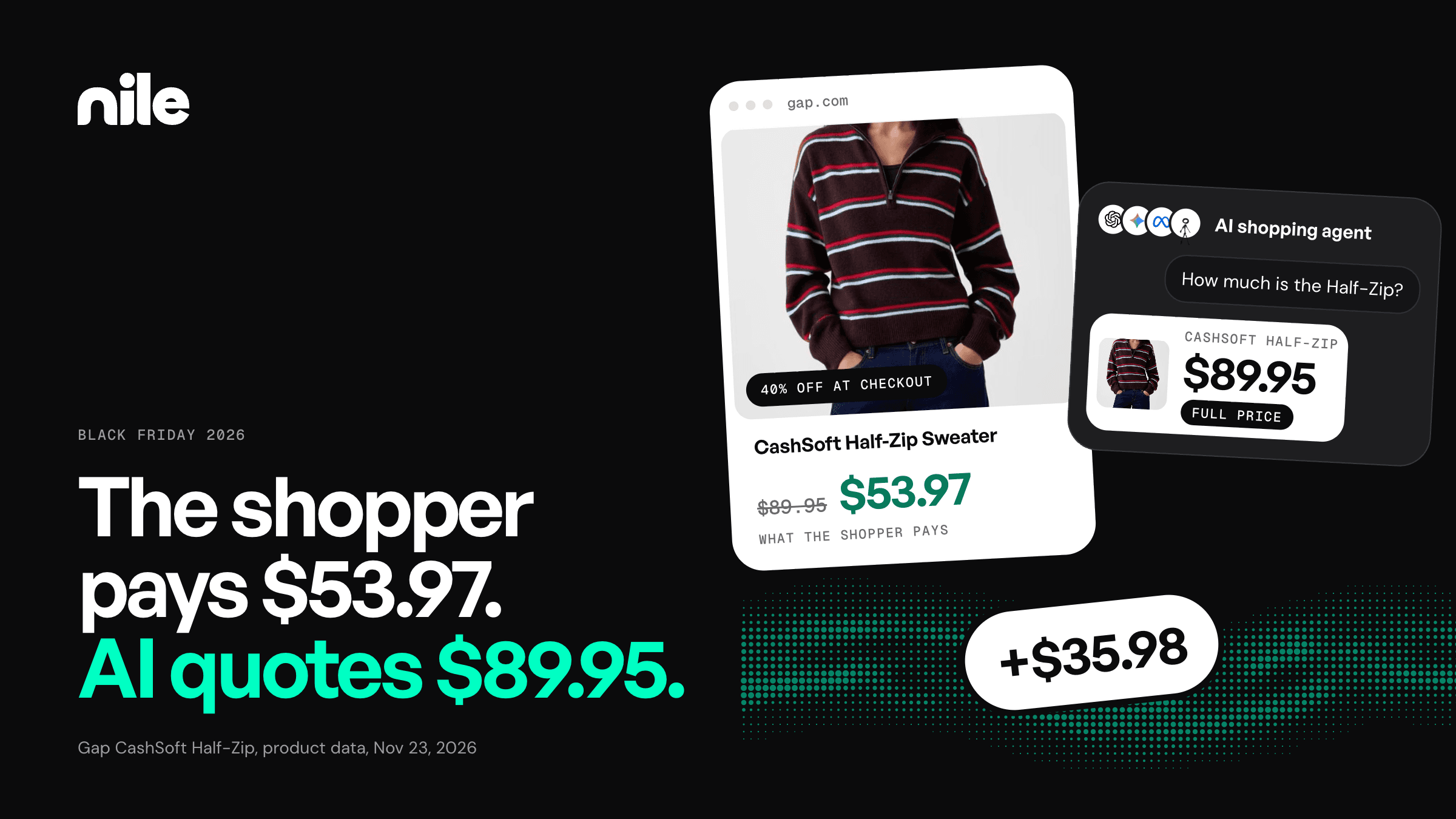
AI shopping agents take your price from product data: the machine-readable price on your product page and in the feeds built from it. A Black Friday discount that only applies at checkout never changes that number. When a shopper asks ChatGPT, Gemini or a personal agent like Meta's Muse or Instinct what your product costs, the agent quotes full price, and a competitor who marked the same kind of product down looks cheaper.
We checked Gap and four DTC bedding brands on November 22 and 23, 2026. Gap had both setups on one page. Two of the bedding brands ran their offer as a code, then moved a discount onto the product within a day. To test your own products, paste a product URL into our free Black Friday price check.
Where an agent gets your price
There are three places, and each holds one number per product for the current price.
- Structured data on your product page. Google's merchant listing guidance defines the schema.org
priceas the price at which the product is currently offered. The regular price during a sale goes in a separate strikethrough price. - OpenAI's product feed. The spec has a required
pricefor the regular price and an optionalsale_pricefor the current sale price. Its instruction to merchants is to update the feed when a sale starts or ends. For Shopify stores, OpenAI's help center says ChatGPT gets merchant data through Shopify Catalog. - Google Merchant Center. It has its own
sale_price, with an optionalsale_price_effective_datefor the sale window. Promo codes are handled separately, as promotions.
OpenAI's help center also says that when merchants change prices, there may be some delay before ChatGPT shows the new one.
Four places a discount hides from agents
A discount that never touches the product's price field is invisible to an agent. We see it in four places.
- A sitewide banner. "40% off everything" is text on a page. It isn't attached to any product's price.
- A code in an ad, an email or an SMS. The shopper types it in the cart. The product price stays the same.
- A Shopify automatic discount or discount code. Shopify applies both in the cart and shows the saving at checkout.
- A price your theme recalculates with JavaScript. The shopper sees the lower number after the page loads. The structured data in the page source still holds the old one.
Gap: two sweaters, two answers
Gap is running "40% off everything" for Black Friday. On its women's sweaters page on November 23, 2026, two sweaters sat in the same grid under the same banner.
- CashSoft Crew Sweater: marked down on the product from $69.95 to $27.00. The structured data says
"price": 27.00. An agent quotes the sale price. - CashSoft Oversized Half-Zip Sweater: listed at $89.95 with "40% off at checkout." The structured data says
"price": 89.95for every size and color. A shopper on gap.com pays $53.97. An agent quotes $89.95, which is $35.98 more.
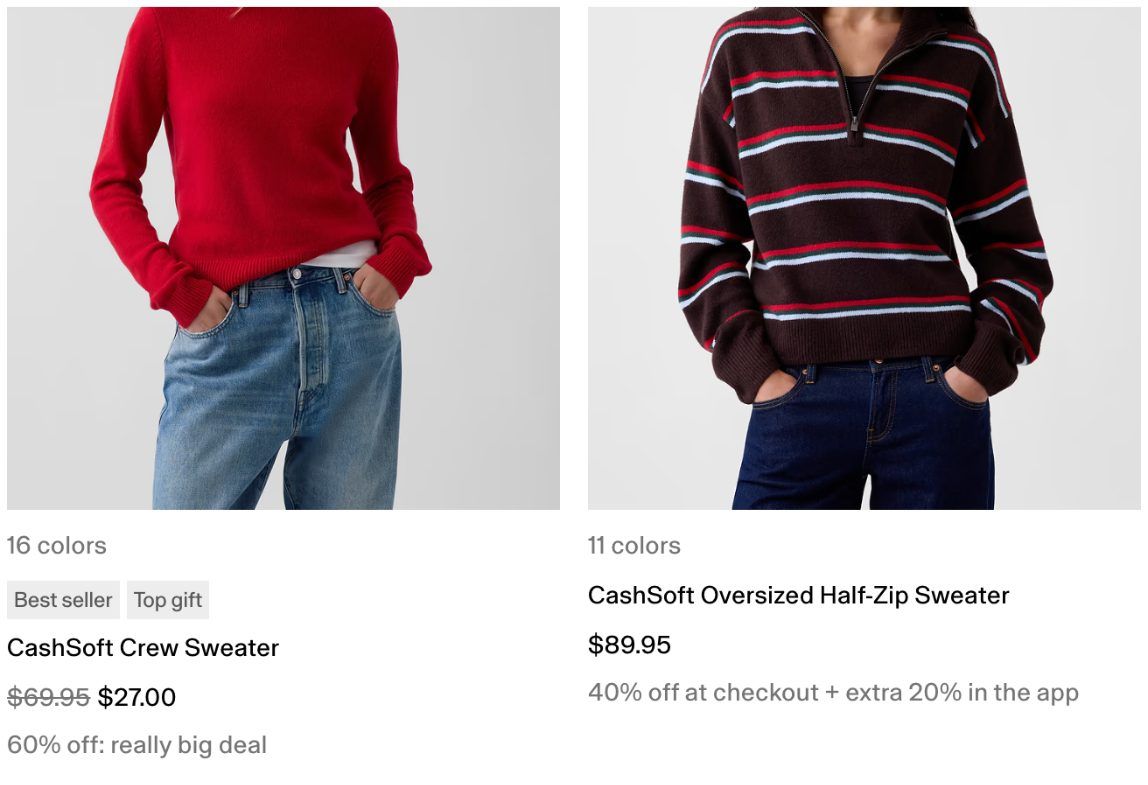
The gap matters most when a shopper sets a budget. Ask for a half-zip sweater under $60, and an agent working from product data has no reason to include this one, even though it sells for $53.97 on Gap's own site.
Four bedding brands, checked twice
Sheet sets are a category where shoppers compare three or four brands before buying, so a price difference shows up directly in the answer. We checked one sheet set at each of four DTC bedding brands, first on November 22 and 23, then again later on November 23.
| Brand and product | First check | Recheck, later on Nov 23 |
|---|---|---|
| Boll & Branch, Signature Hemmed Sheet Set | 25% off orders over $200 with a code. Product data: $229 to $299, full price | Product data from $183.20, which is 20% below the earlier $229 |
| Brooklinen, Luxe Core Sheet Set | 25% off with a code at checkout. Product data: $169. The page showed $126.75 only after JavaScript ran | Product data from $151.20, which is 20% below the earlier $169 |
| Parachute, Linen Sheet Set | Marked down to $303.20 from $379, in the page HTML | Product data: $303.20 |
| Cozy Earth, Bamboo Sheet Set | 25%-off prices in the structured data | Product data from $202.50 |
Boll & Branch and Brooklinen both moved a discount onto the product within a day. We don't know why, and the code offers may have changed as well. What it shows is that the price an agent reads can change several times during Black Friday week, so one check on Monday doesn't cover Friday.
These are spot checks of one product per brand on the dates shown, not a study.
How to set a sale price agents can read
- On Shopify, put the sale price in Price. Set Price to the sale price and Compare-at price to the original. That is how Shopify's help center describes a sale price, and the product page, its structured data and the feeds Shopify builds from the product all carry it.
- Off Shopify, fix the structured data and the feeds. The schema.org
priceshould be the sale price, with the regular price as a strikethrough price. In feeds, fillsale_pricefor OpenAI and for Google Merchant Center. - Keep codes for your own lists. Email and SMS codes still reward subscribers well. They just shouldn't be the only place your headline offer lives.
- Change prices early. Because updates can take a while to reach ChatGPT, a markdown set on Friday morning may not show until later.
- Plan the switch back. OpenAI's feed spec says sale dates don't schedule price changes, so the regular price has to go back into the feed when the sale ends. Google Merchant Center can use
sale_price_effective_datefor this. On Shopify, a bulk editor or a scheduling app resets prices on time. - Check again on the day. The bedding brands above changed their setup mid-week. Your own theme, apps and discount rules can change the price field too.
Run the check on your own products
Paste a product URL into the Black Friday price check. It reads the price in your product data, which is what an agent quotes, and shows it next to the price a shopper pays. Start with your best seller, since that is the product an AI shopper is most likely to compare.
Frequently asked questions
Why does ChatGPT show a higher price than my website during a sale?
ChatGPT takes the price from product data, either the structured data on your product page or a product feed. If your discount is applied in the cart or at checkout, through a code or an automatic discount, the product data still holds the full price. OpenAI also says price updates can take time to show.
Should a Black Friday price go in price or sale_price in a product feed?
In OpenAI's product feed and in Google Merchant Center, price holds the regular price and sale_price holds the current sale price. On a product page, schema.org price should be the current sale price, with the regular price marked as a strikethrough price.
How often should I check my prices during Black Friday week?
Check on the day the sale starts and again after any change to discounts, apps or your theme. In our spot checks, two bedding brands changed the price in their product data within a day.
Sources
- Shopping with ChatGPT Search — OpenAI Help Center (accessed 2026-11-23)
- Product feed spec — OpenAI (accessed 2026-11-23)
- Merchant listing (Product, Offer) structured data — Google Search Central (accessed 2026-11-23)
- Sale price [sale_price] — Google Merchant Center Help (accessed 2026-11-23)
- Sale pricing — Shopify Help Center (accessed 2026-11-23)
- Discounts — Shopify Help Center (accessed 2026-11-23)
- Women's sweaters — Gap (accessed 2026-11-23)
- Signature Hemmed Sheet Set — Boll & Branch (accessed 2026-11-23)
- Luxe Core Sheet Set — Brooklinen (accessed 2026-11-23)
- Linen Sheet Set — Parachute (accessed 2026-11-23)
- Bamboo Sheet Set — Cozy Earth (accessed 2026-11-23)