
In early September, the considered industry view was that personal shopping agents were the second curve: real, but 12 to 24 months out. Then Meta shipped Muse on September 8. Three weeks later it had 3.4 million downloads. By October 3 it had passed five million, with Walmart, Gap, Sephora, Expedia, Wayfair, and Best Buy signed on as retail partners, Shopify wired in on the merchant side, and Stripe's Link supplying the delegated payments underneath. The forecast did not get revised. It got overrun.
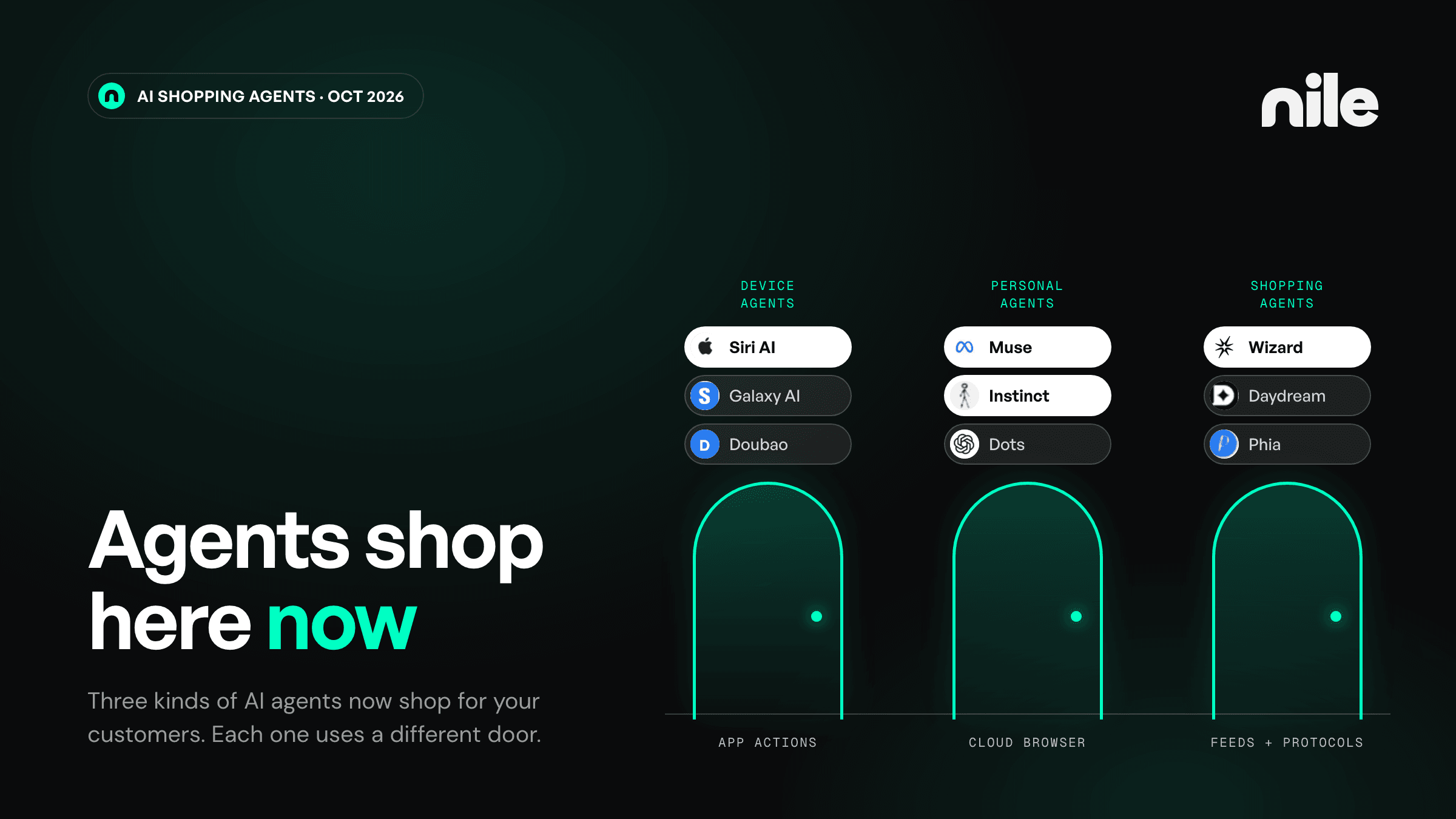
The things now shopping on your customers' behalf are not one thing. They are three different kinds of AI agents, and each one reaches your store by a different door. That taxonomy, not a winner prediction, is what a store can act on.
Six weeks that moved the timeline
Four launches and a funding round, in order:
- September 8. Meta launches Muse: a free personal agent with a dedicated cloud virtual machine per user, distributed to the Facebook and Instagram user base.
- September 14. Apple ships Siri AI with iOS 27. It reads the screen and personal context and acts inside apps, with App Intents as the only channel for developers.
- September 28. Instinct, an invite-only personal agent you reach by text, call, or email, raises $1 billion at a $10 billion valuation, one month after raising at $2.5 billion.
- September 28, same day. Shopify extends WebMCP to checkout, giving browser-class agents sanctioned tools to complete a purchase with the buyer's authorization.
- Through it all. Wizard, the shopping-only agent from Marc Lore and Melissa Bridgeford that launched publicly in February, keeps adding native checkout retailers on the Agentic Commerce Protocol rails it helped Stripe pioneer.
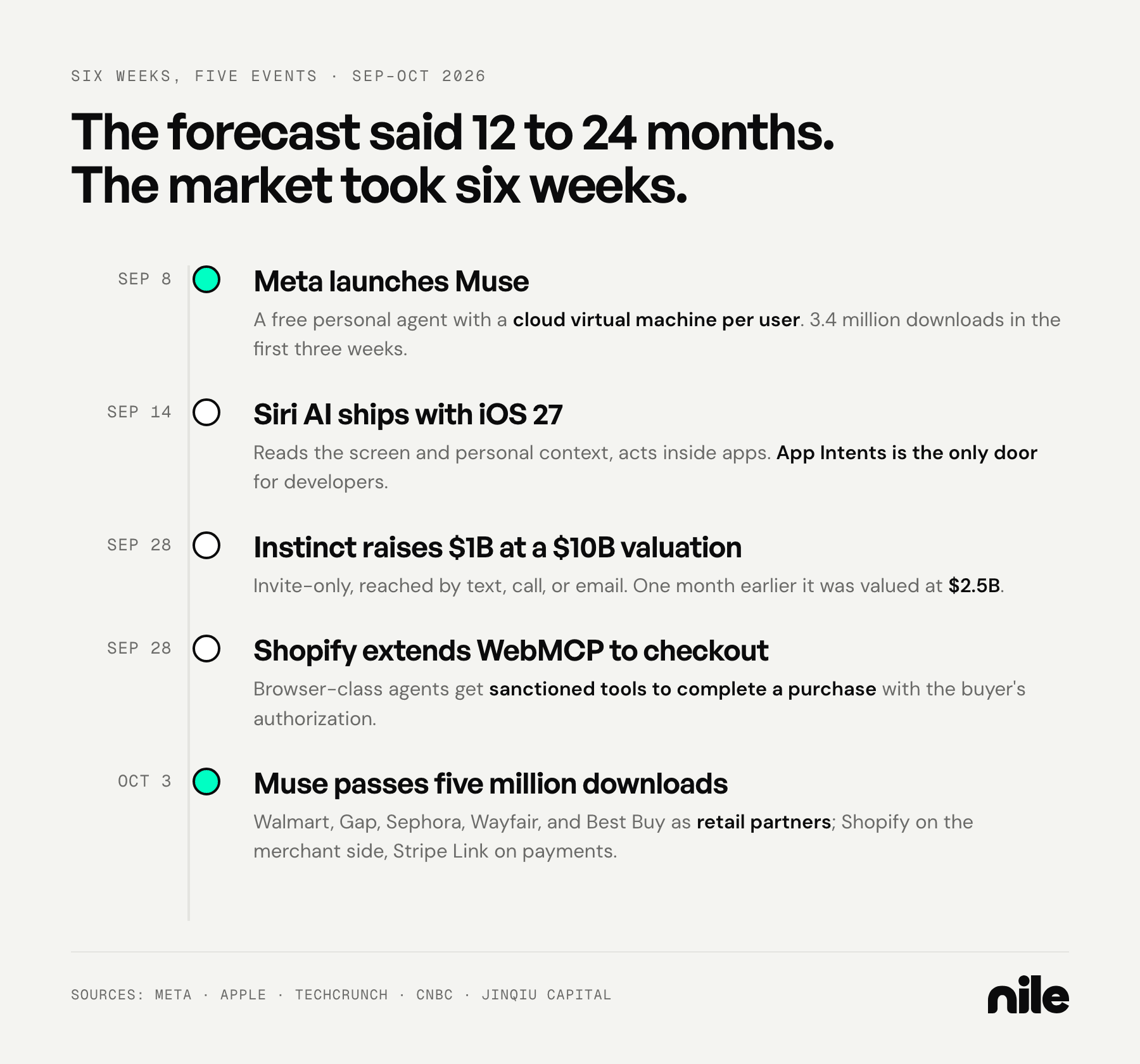
Two of these companies now hold a combined valuation north of $12 billion with roughly 100,000 disclosed users between them. Skepticism about the valuations is fair. The user behavior underneath them is harder to dismiss.
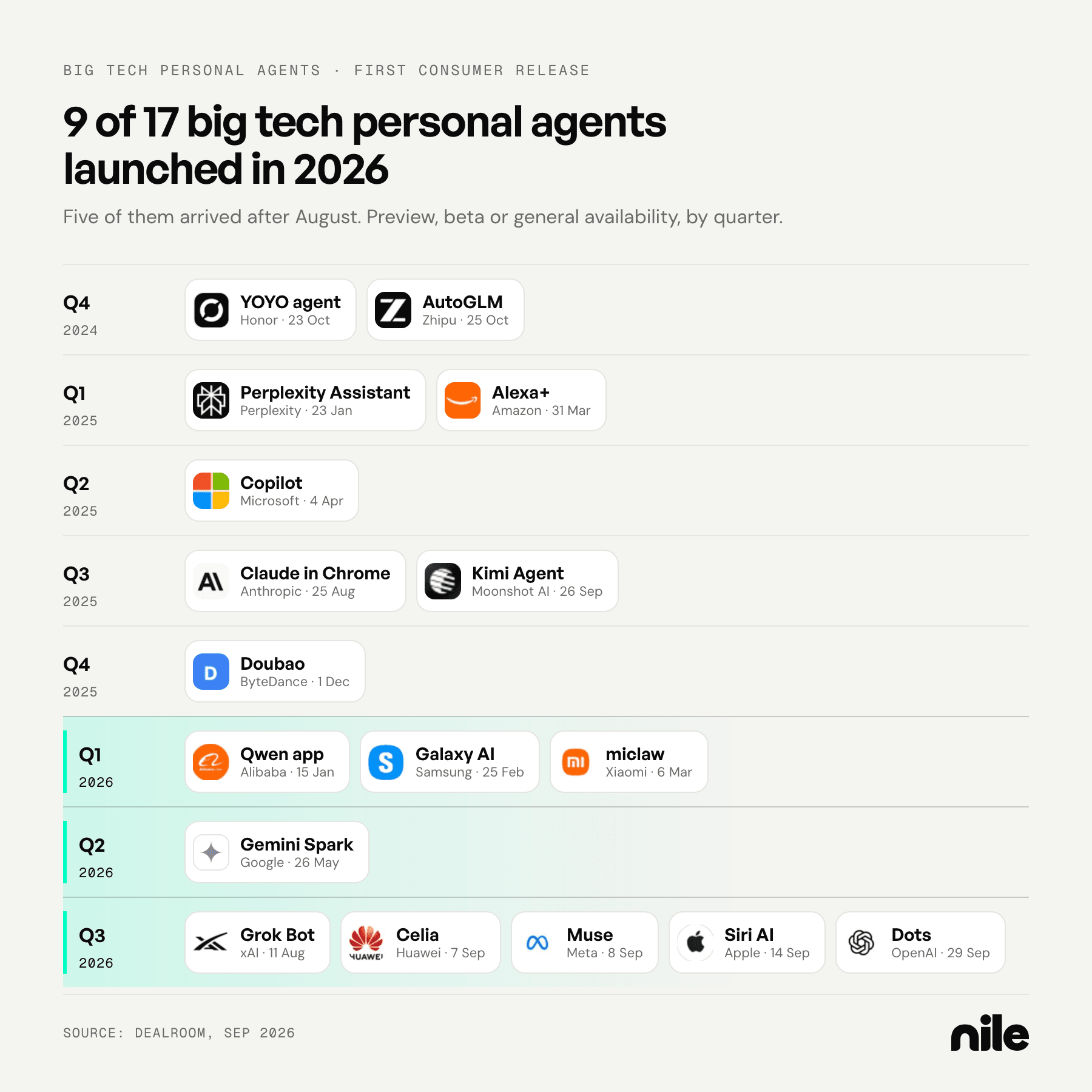
Zoom out, and the six weeks look like the steepest stretch of a longer climb. Per Dealroom, 9 of the 17 big tech personal agents reached consumers in 2026, and five of them arrived after August.
What people actually delegate
The best public evidence so far is an analysis of 673 deduplicated public Muse use cases, collected from public case-sharing sites in September. The usual caveats apply: people publish successes, not failures, and savings figures are self-reported. With that stated, three findings stand out.
1. The work is mundane. Money recovery, shopping errands, travel arrangements, and household admin together account for 75.3% of cases. Shopping and procurement alone appear in 21.4%: filling an Instacart cart overnight, hunting promo codes, comparing options, messaging marketplace sellers to negotiate a used MacBook.
2. The economics are concrete. Among the 107 cases that named a dollar amount, the median was $250: a canceled pet insurance policy, a decade-old subscription refunded, an airline fee clawed back.
3. The relationship is young. 82.2% of cases were one-off errands. Only 17.8% showed the agent holding recurring responsibility. People are testing these agents the way you test a new employee: small tasks first. A PYMNTS Intelligence survey found the same caution from a different angle: 56% of consumers said they would let an agent search and compare products, but only 35% would hand it their saved payment details.
The pattern has a name worth keeping: patience arbitrage. Much of consumer commerce quietly profits when people give up: the unclaimed refund, the forgotten subscription, the price adjustment nobody requests. An agent with infinite patience and near-zero marginal cost collects what people abandon. That is the demand side of this market, and it is also a warning we will return to in the companion playbook.
The three kinds of agents, and the door each uses into your store
The field is crowded. Dealroom's map of personal AI agents counts 120 companies, from big tech agents to open-source projects to startups that live inside your messages.
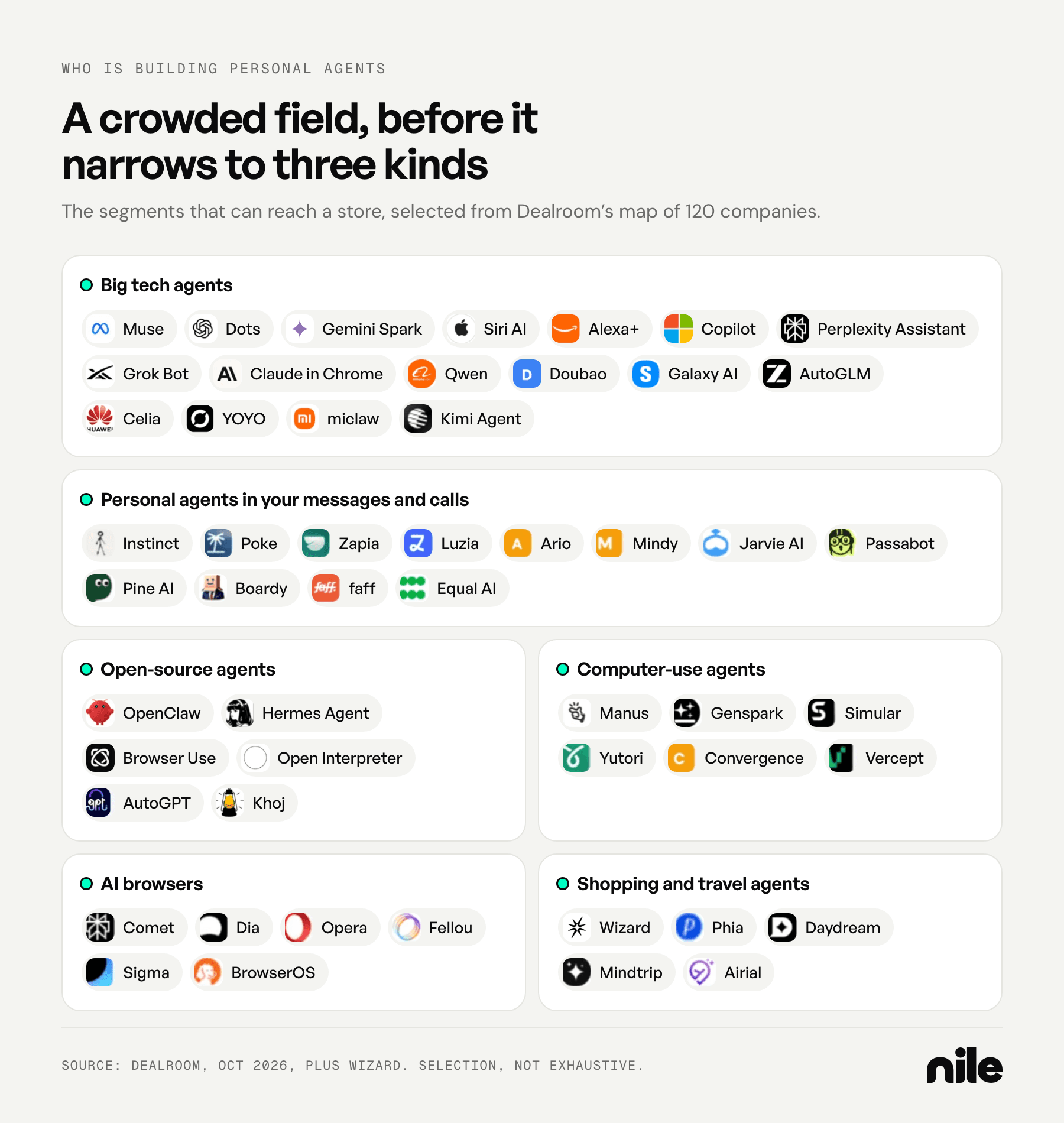
Sort those companies by where they meet the customer, tag each with the door it uses into a store, and six groups emerge. Some run inside a device and call app actions. Some browse your site like a person and pay with a delegated card. Some consume your product feed as structured data. And some sell only their own platform's shelf.
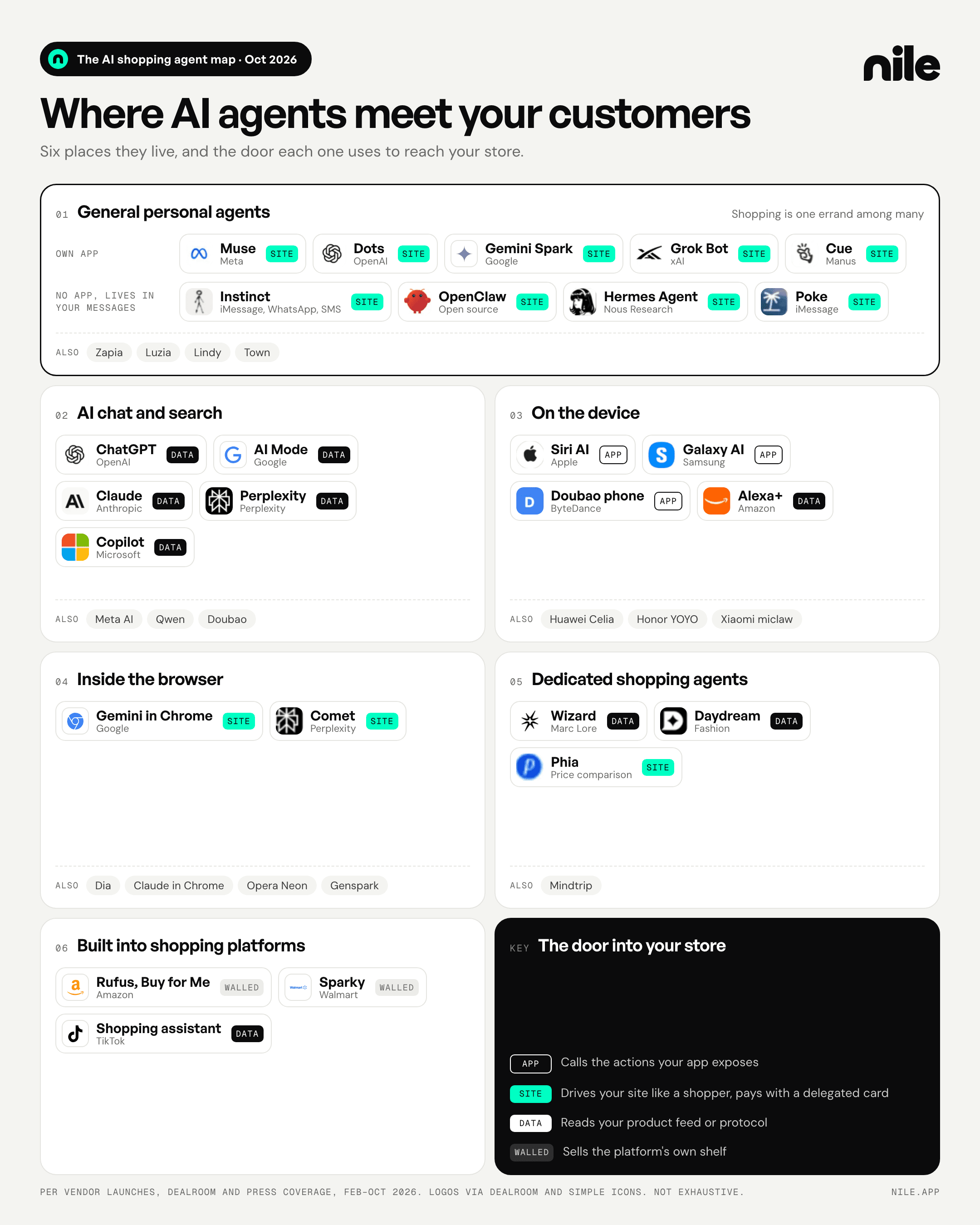
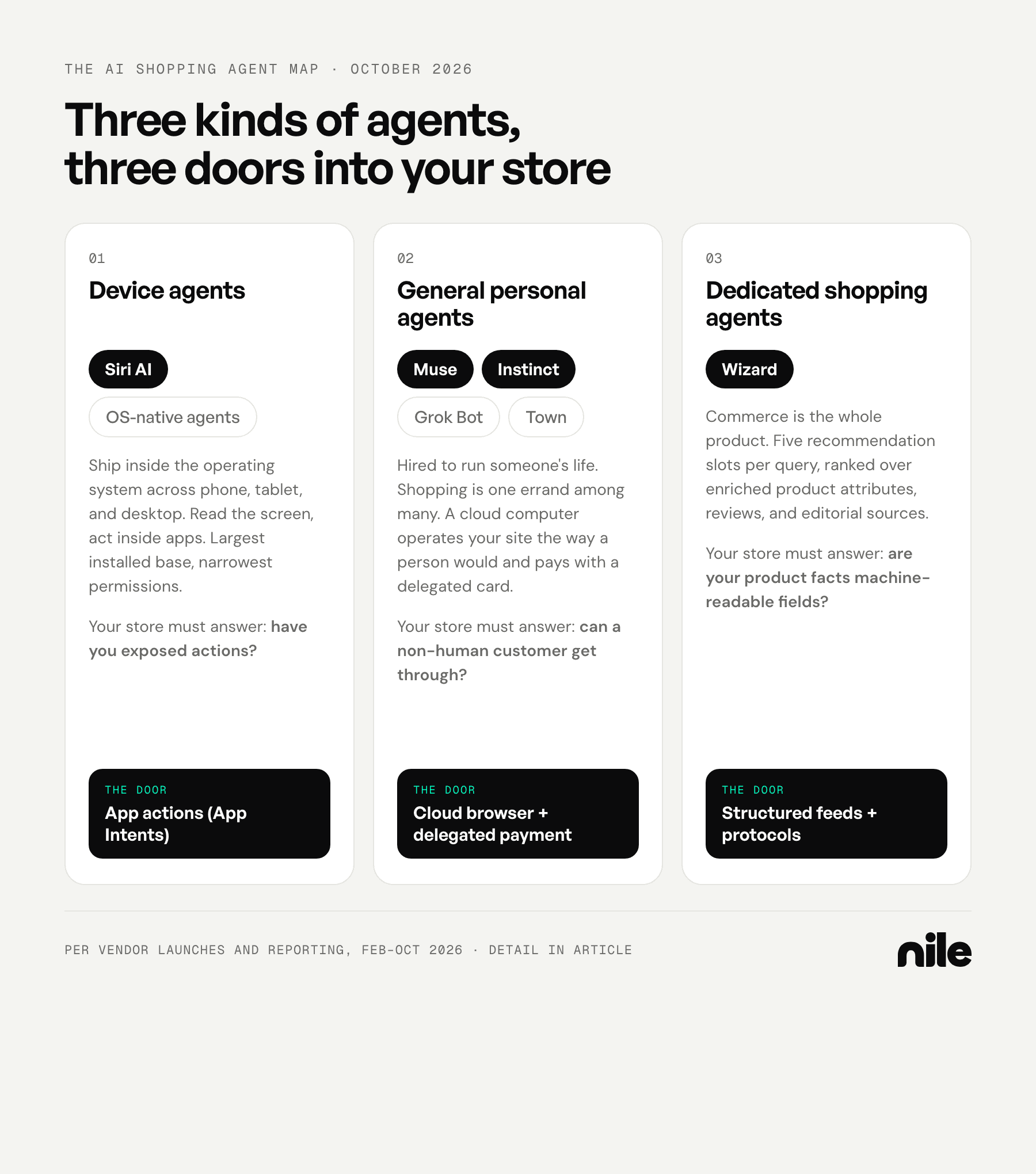
For a store, three of those six groups are the ones that actually buy from you. Each reaches your store through a different door.
1. Device agents
Examples: Siri AI (Apple), Galaxy AI (Samsung), the Doubao phone (ByteDance), Celia (Huawei), YOYO (Honor)
The agent that ships inside the operating system, across phone, tablet, and desktop. Siri AI reads what is on the screen, carries personal context from mail, messages, calendar, and photos, and acts inside apps. Its door into commerce is App Intents: apps expose actions, and the agent calls them. There is no site to crawl and no browser session to detect. If your brand's buying surface is an app, you are visible to Siri AI exactly to the degree that you have exposed actions, and invisible otherwise.
Apple is not the only company shipping this pattern. ByteDance, TikTok's parent company, launched the Doubao phone with its own AI agent embedded at the OS level, and Samsung's Galaxy AI is moving in the same direction. Any device maker or internet platform with a large enough installed base can build this door. The playbook is the same: control the operating system, control which actions the agent can call.
Device agents have the largest installed base and the narrowest permissions. They will likely be the highest-volume, lowest-autonomy kind for the next year: strong at handoffs, cautious at checkout.
2. General personal agents
Examples: Muse (Meta), Dots (OpenAI), Gemini Spark (Google), Grok Bot (xAI), Cue (Manus), Instinct and Poke inside your messages, and open-source agents such as OpenClaw and Hermes Agent
The agent hired to run someone's life, for which shopping is one errand among many. Nearly every major AI lab now ships one, and startups reach people through messaging apps or as open-source software they run themselves. Two of them show how far apart the bets are.
Muse is the free, mass-market version. Every user gets a cloud virtual machine, and the agent operates the web the way a person does: it browses, fills carts, and checks out. Analysis of Muse's code by MBI Deep Dives identifies three checkout modes: driving the merchant's site in a browser, Shopify's API, and Stripe Link. The same analysis argues Muse may never carry ads, because its browsing already registers on merchant site tags and feeds Meta's ad systems the ordinary way. Treat that as one analyst's reading of the code rather than a Meta commitment, but the design direction is clear: the agent is free, and the commerce flows around it are not.
Instinct has no app at all: also free, but invite-only, reached by text, call, or email, running on its own phone and computer. Its founder, Noah Shinn, says more than $1 billion a year in transactions already flows through the platform, roughly half of it travel, with the company taking a cut of transactions instead of selling ads. The architecture claim is more checkable: Instinct pays with human-approved one-time virtual cards through Stripe Link and operates merchant sites directly, which means merchants currently have no integration surface with it at all. It arrives looking like a customer.
The open question for this category is platform risk. Instinct lives inside WhatsApp and iMessage. If Meta or Apple decide to promote their own agents inside those channels, or restrict third-party agent access the way Amazon blocked Muse, Instinct's distribution disappears overnight. And whether anyone can sustain the compute subsidy except a company the size of Meta is genuinely unsettled. What is settled is that both products exist, both transact, and both grew faster than any forecast said they would.
3. Dedicated shopping agents
Examples: Wizard, Daydream (fashion), Phia (price comparison), Mindtrip (travel)
The third kind does nothing but commerce, and most of them specialize in one vertical or one job. Wizard is the clearest example. Founded by Melissa Bridgeford and Marc Lore after a nearly five-year private beta, it returns exactly five recommendations per query, ranked by a proprietary system over enriched product attributes, review analysis, and editorial sources. It is deliberately not a general-purpose agent: no inbox, no calendar, no life admin.
Its door is the most familiar one: structured data over protocols, meaning your catalog delivered as machine-readable fields rather than pages to browse. Wizard joined Stripe's early Agentic Commerce Protocol partners in March and runs native checkout with retailers, starting with Best Buy. For a merchant, a dedicated shopping agent looks like a new retail channel with an unusually demanding buyer: it consumes your catalog as fields, not pages, and its five-slot result page has no long tail to hide in.
The same pattern, ten years older
Skeptics have a strong precedent to point at. In 2015, a wave of personal assistant startups sold exactly this promise: text Magic or Operator to buy something, message Fin to run an errand, ask Facebook M inside Messenger, or CC x.ai (the scheduling assistant, years before the name meant anything else) to book a meeting. None of them survived in that form. Automation never caught up with task complexity, and humans behind the curtain destroyed the margins. A second wave from 2021 to 2024, including Inflection, Adept, Humane, and rabbit, ended mostly inside big tech: per Dealroom, all five that sold were bought by big tech companies.
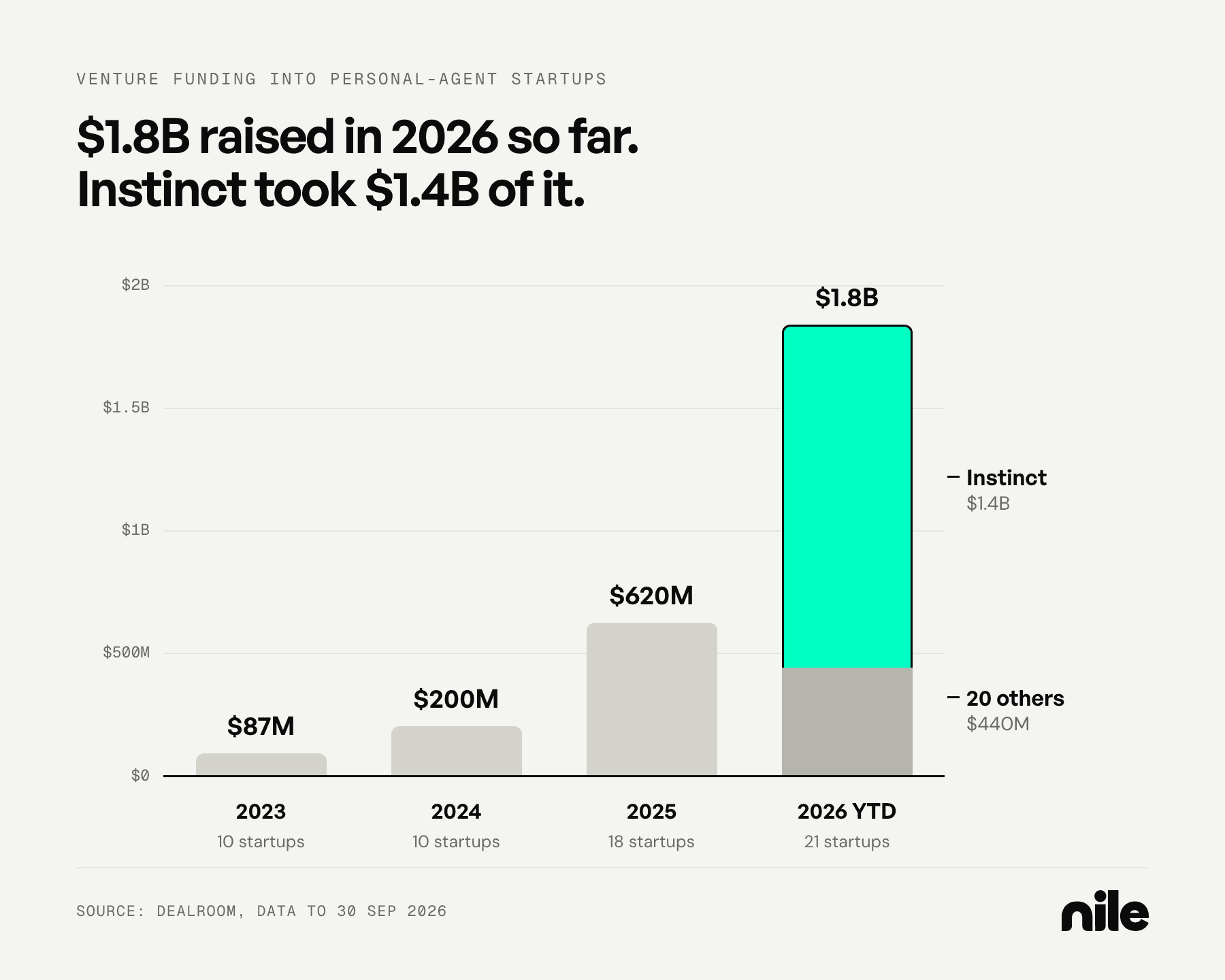
This cohort holds five cards the 2015 one did not: models that can actually operate a website, cloud execution environments that persist for days, runtimes built for long background tasks, one-time payment credentials that make delegated spending safe enough to try, and, in Meta's and Apple's cases, distribution measured in billions. Whether those five cards beat the old economics is the open question. The 82% one-off figure says retention is unproven. The $12 billion in combined private valuations says investors have decided not to wait for the proof. Per Dealroom, 21 personal-agent startups raised $1.8 billion in the first nine months of 2026, and $1.4 billion of it went to Instinct alone.
What this means if you sell things
Each kind of agent asks a different question of your store:
- The device agent asks: have you exposed actions? If the answer lives only in your app's pixels, Siri AI cannot call it.
- The personal agent asks: can a non-human customer get through? It arrives via a cloud browser with a virtual card. Your bot defenses, login walls, and checkout flow decide whether it completes the purchase or recommends a competitor that lets it. Amazon blocked Muse twelve days after launch, citing its conditions of use. But after the Ninth Circuit vacated an earlier injunction against Perplexity's Comet browser, ruling that the user, not the AI company, is the one accessing the retailer's computers, the legal footing for keeping agents out narrowed to contracts and bot detection.
- The shopping agent asks: are your product facts machine-readable fields? Five recommendation slots, filled by ranking systems that consume attributes and verified claims, not adjectives.
Keeping one catalog legible to all three kinds at once is the job of a product context layer. We have written separately about what product pages need to become when agents do the reading, and about why being mentioned is not being bought. The companion piece to this one turns the landscape into decisions: whether to let agents in, what to fix first, and how to measure what they buy.
For now, one number is worth keeping in view. In the 673 public cases, shopping was already a fifth of what people delegated, in the product's first month, before most merchants had decided whether to let the agent through the door. The customer did not wait for the forecast either.
Frequently asked questions
What is an AI shopping agent?
An AI shopping agent researches, compares, and in some cases completes purchases on a person's behalf. Unlike a chatbot that answers questions, a shopping agent holds context about the person, operates websites or apps directly, and can pay with delegated credentials such as a one-time virtual card.
What is the difference between Muse, Instinct, and Wizard?
Muse is Meta's free general personal agent with mass distribution and a cloud virtual machine per user. Instinct is a premium invite-only personal agent reached by text, call, or email, monetized by a take rate on transactions. Wizard is a dedicated shopping agent that only does commerce, returning five recommendations per query and checking out natively with partner retailers.
Do AI shopping agents actually complete purchases today?
Yes, within limits. Muse checks out through a browser session, Shopify's API, or Stripe Link depending on the merchant. Instinct's founder says more than $1 billion a year in transactions already flows through it. Most delegated tasks are still research, comparison, and errands rather than autonomous buying.
Sources
- Agent 助理爆了:Instinct 估值过百亿美元、Muse 340 万下载 — Jinqiu Capital
- Meta's Muse can shop and check out for you. Here's how it works — CNBC
- Viral AI agent Instinct raises $1B Series C at a $10B valuation — TechCrunch
- Noah Shinn - Building Instinct: The Personal Agent (Invest Like the Best EP.493) — Colossus
- Wizard Launches AI Shopping Agent Purpose-Built for Ecommerce — Wizard
- Meta's Muse can skip ads yet still shape Instagram ads, MBI argues — PPC Land
- Shopify expands WebMCP support to checkout — TechCrunch
- Personal AI agents are back: nine big tech launches and 21 startups raising money in 2026 — Dealroom
- Seven AI Shopping Agents, Compared From the Retailer's Side of the Till — The AI Commerce Brief