
If your store's Google traffic fell this year while your rankings held, the cause worth checking first is that Google started answering the question itself, before the reader ever got to you.
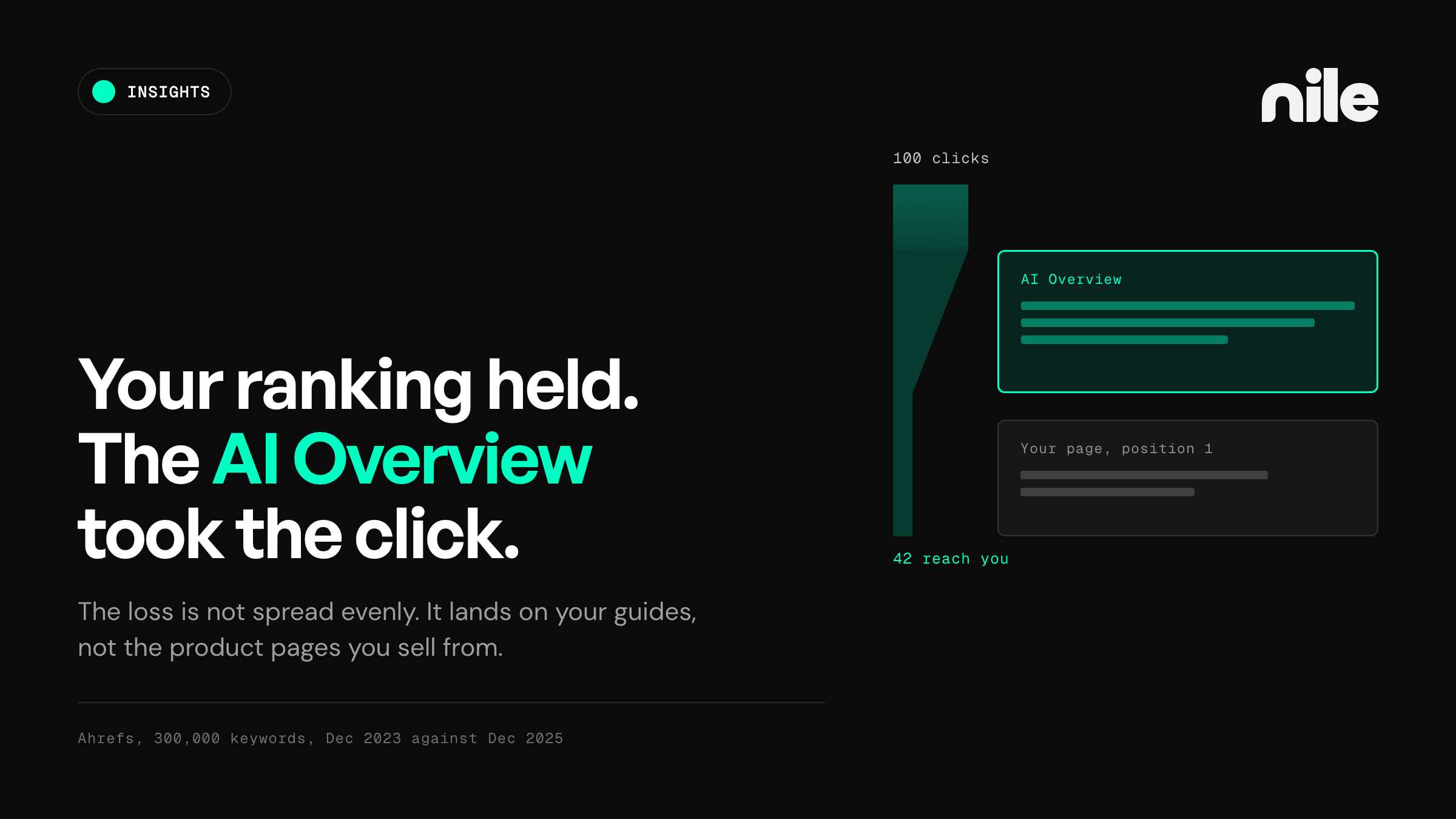
On the keywords where Google prints an AI Overview, its own AI-written answer, the page ranking first gets 58% fewer clicks than the same page would have earned before AI Overviews existed, on Ahrefs figures.
Your position can be identical to last year and your store's clicks can be down by half, with nothing wrong on your site at all.
That number is measured on informational searches, so it does not describe your store evenly. How much of your own fall it explains depends on the kind of pages you rank with. Read it as a store-wide forecast and you will spend a quarter rewriting pages that never lost anything.
Zero-click search broke the link between rankings and clicks
For twenty years position and traffic moved together. Rank third instead of eighth, get more clicks. That relationship is what made rank tracking a proxy for business health, and it is the relationship that broke when the reader stopped clicking. A zero-click search is one where the reader gets what they came for on the results page and never visits a site, and a growing share of searches now end that way.
Ahrefs took 150,000 keywords that show an AI Overview and 150,000 informational keywords that do not, then compared average desktop click-through from Search Console in December 2023 against December 2025. Desktop only, which matters, because the surface where AI answers are hardest to scroll past is the phone.
The keywords without an AI Overview are doing the important work there. They show how much click-through fell over those two years for reasons that have nothing to do with AI: more ads, more Google-owned results, changing habits. Subtract that ordinary decline, and the extra drop left on the AI Overview keywords is 58% of the clicks the top page used to earn. Ahrefs ran the same measurement eight months earlier and got 34.5%, so the gap is widening. The answer arrived above you and the reader stopped.
AI Overviews are one cause of zero-click, not all of it
Featured snippets end a search without a click, so does the local pack, and so does Google sending the click to one of its own properties. An AI Overview is the newest of that group and the fastest growing, which is why a fall in your clicks is not by itself evidence of one.
SparkToro's clickstream analysis found that in the first four months of 2026, 68.01% of United States Google searches ended that way, up from 60.45% in 2024. Clicks going anywhere at all, including to Google's own properties, fell 9.51 percentage points over the same period. That study runs on browser clickstream data and excludes the Google mobile app, so the real zero-click share is probably higher than the figure it reports.
How to tell an AI Overview loss apart from a penalty
The two look identical in a traffic graph and they need opposite responses, so separate them before you touch anything.
A penalty or an algorithmic demotion moves your position. Impressions fall with clicks, and the queries you used to win disappear from the report entirely.
An AI Overview loss looks opposite. Impressions hold or grow while clicks fall, average position stays flat, and the queries you used to win are still ranking. What changed is the share of readers who needed to click to get what they came for.
In Search Console, plot clicks and impressions on the same chart over sixteen months and look at whether they diverge or fall together. Divergence points at an answer above your listing. Before you commit to that reading, rule out the other things that make the same shape on those queries: a new ad block, another SERP feature, or a title rewrite that cost you the click. Falling together is something else, and that something else deserves a real diagnosis rather than a new optimization project.
The loss is concentrated, not spread evenly
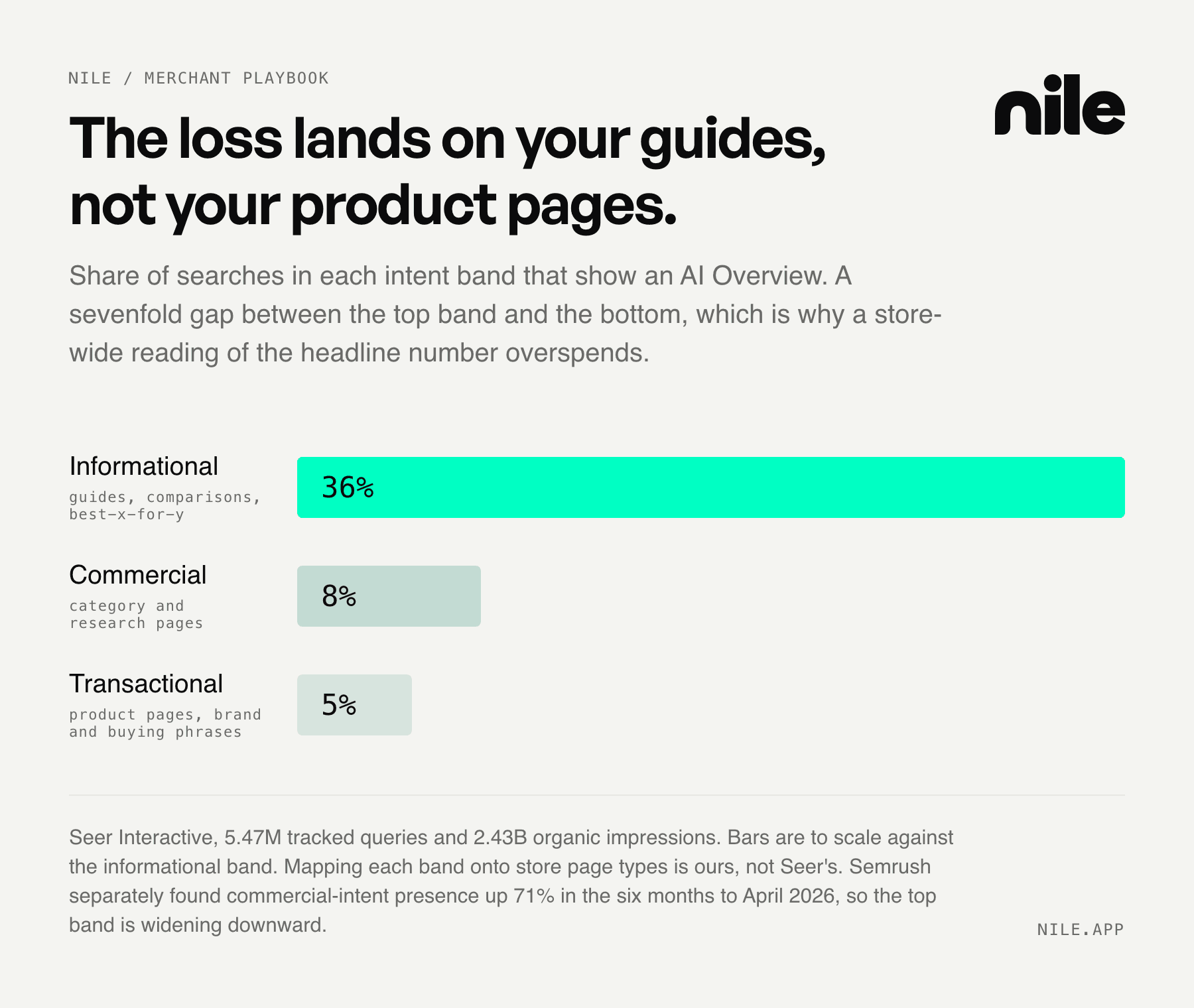
AI Overviews are not distributed evenly across search intent. Across 5.47 million tracked queries and 2.43 billion organic impressions through the first quarter of 2026, Seer Interactive found AI Overviews on 36% of informational searches, 8% of commercial searches, and 5% of transactional searches. That is roughly a sevenfold gap between the top and the bottom.
For a store, that maps onto page types you already recognize. Your guides, comparisons, and "best something for something" content sits in the informational band where exposure is high. Your product and category pages, the ones people reach with a brand name or a buying phrase, sit in the band where exposure is low.
Some stores have almost no guide traffic, others have half
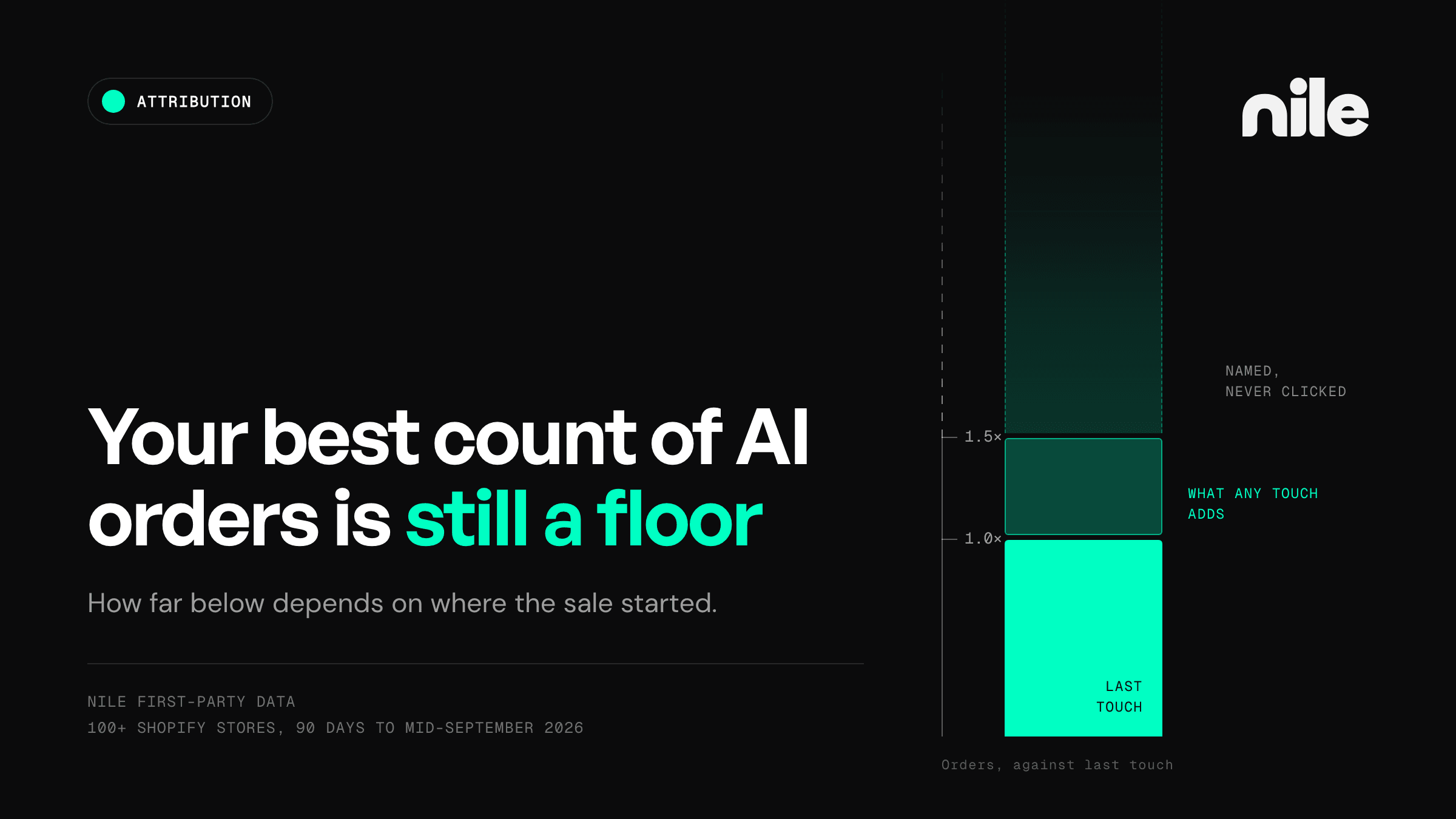
That mapping tells you which pages are exposed. It does not tell you how much of your store sits in that band. Stores differ there more than the bands differ from each other. Take a sample of roughly a hundred Shopify stores with enough Google traffic to measure, over the 90 days to mid-September 2026. In the median one, guide and blog pages took about a tenth of the Google organic landing traffic, and product pages about a third. Four in ten stores took under 5% on guides. One in six took more than half.
Those are the shares today rather than a measurement of anything lost, because they describe where traffic lands now and not where it landed before AI Overviews. Use them to size your own exposure before you spend anything. Your analytics will give you your own split in about a minute, sorted by the page each session landed on, and a store-wide reading of the headline is wrong for nearly every store in one direction or the other.
On a buying query, your product feed is a second way in
Semrush tracked more than 600,000 keywords across ten industries from November 2025 to April 2026 and found AI Overview presence on commercial-intent searches grew 71% over those six months, while transactional-intent presence fell 5%. The pressure is moving up the funnel toward research and comparison. It is not, so far, arriving at the moment of purchase.
When an AI Overview covers a shopping question, the products inside it come from the Shopping Graph, which your Merchant Center feed populates. None of that runs through your rankings. Google reports it separately from Search. Merchant Center's AI performance report covers conversational shopping queries on AI Mode and AI Overviews, limited to organic AI traffic, meaning free listings rather than pages. AI Mode is Google's conversational search surface, a separate place from the results page an AI Overview sits on.
So the products inside that block do not arrive by ranking. They arrive from your feed, which is a separate input from the pages your SEO work improves. Google's own advice in that report is to populate the product attributes you are missing, which is the same instruction as the one above arriving from the other direction.
What being cited in an AI Overview is worth
Being cited inside the AI Overview earns 120% more organic clicks per impression than appearing on the page without being cited, on Seer's figures. It still comes in 38% below what the same query returned with no AI Overview at all. Put those two ratios on one baseline and the uncited case lands near 28 against 100, which is arithmetic from Seer's figures rather than a third number Seer published.
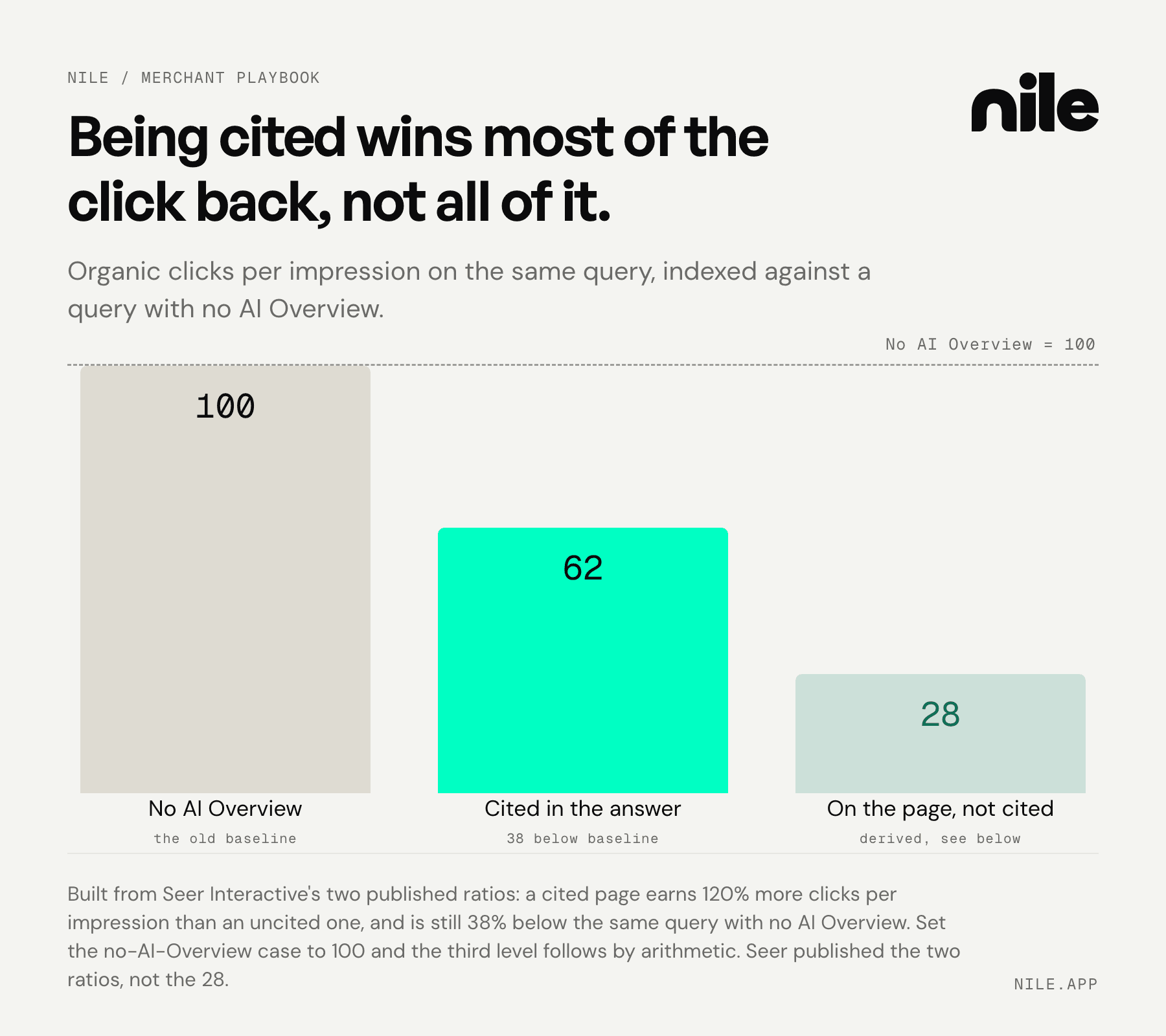
Citation is a large recovery and a partial one. Anyone selling you a full recovery is selling.
Seer also recorded organic click-through on AI Overview queries rebounding 85% in two months, from 1.3% in December 2025 to 2.4% in February 2026. That is 1.1 points on a very low base, so it is not a recovery to plan around. It is a reason to re-measure rather than extrapolate.
Opting out removes you, not the AI answer
The reflex is to shut off access. Three different levers get confused in that conversation. They do three different things, and as of this summer one of them genuinely works.
| Lever | Removes you from AI Overviews? | What it costs you |
|---|---|---|
| Google-Extended | No. Governs training and grounding in Google's other AI systems, not Search | Nothing, because it does nothing here |
nosnippet, data-nosnippet, max-snippet |
Yes | Your ordinary search snippet, on every result, for every query |
| The search generative AI control, June 2026 | Yes | Nothing visible. Google states it is not a ranking or inclusion signal elsewhere in Search |
Google-Extended. This is the token most people reach for, and it has never done the job. It governs training and grounding in Google's other AI systems, and Google states plainly that it does not affect inclusion or ranking in Search. AI Overviews and AI Mode read the ordinary index that Googlebot builds. Google's documentation says a page has to be indexed and eligible for Google Search before it can appear as a supporting link in either. Disallow Google-Extended and your pages stay exactly as eligible as they were.
The snippet directives. nosnippet, data-nosnippet, and max-snippet now apply to AI features as well as ordinary results. These do work, and they are blunt instruments. They also strip your own search snippet, on every result, for every query.
The search generative AI control. Since June 2026 there is a dedicated switch in Search Console. It removes your content from AI Overviews, AI Mode, and generative features in Discover, and Google states that it "isn't used as a ranking or inclusion signal affecting other parts of Search." No collateral damage, no lost snippets. Google is rolling it out to a subset of site owners, so if it is not in your property yet, that is the rollout rather than you. Exclusion takes a day or two to propagate.
So a clean opt-out exists. Before reaching for it, read Google's own sentence describing what it buys: "You won't receive any traffic or impressions from these features."
Opting out does not remove the AI answer. It removes you from the AI answer.
The overview still appears and still ends the session, now assembled from pages other than yours. No click comes back to you, and you have left the surface where the decision gets made.
Of the three levers, the generative AI control is the dangerous one. It costs you nothing visible, so nothing about it makes you stop and think.
What still earns the click when an AI answer sits above you
The question stops being "how do I rank" and becomes "am I in the answer, and is what it says about me correct".
Three things follow, in order of how much they move.
Get cited inside the answer. Citation is worth 120% more clicks per impression than sitting uncited on the same page, which makes it the single largest available lever on an AI Overview query. Content that states a specific, checkable claim near the top gets pulled into answers. Content that takes four paragraphs to reach its point gets summarised without attribution.
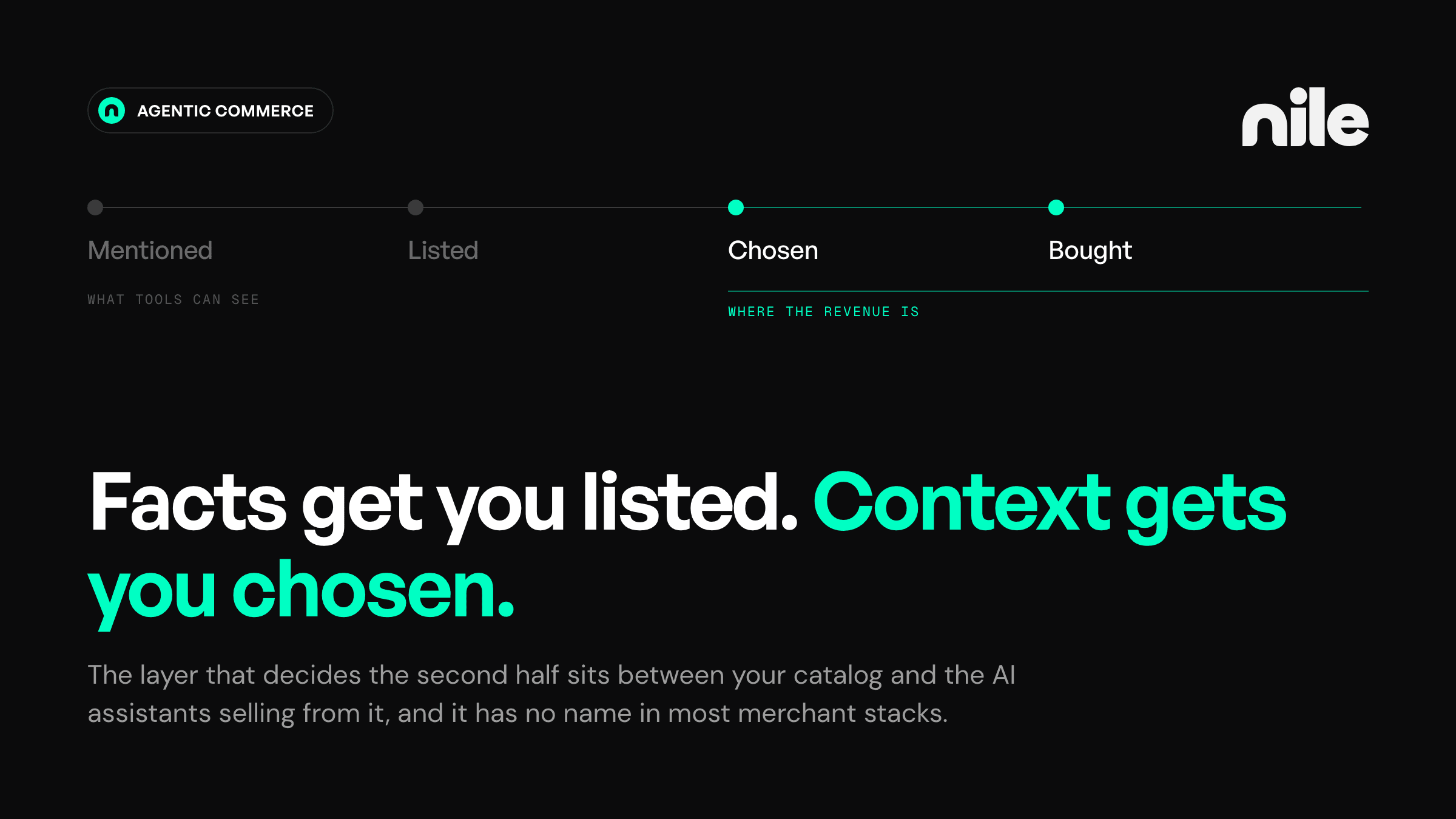
Complete the product data. When an AI assistant fields "a waterproof jacket for a rainy commute under $200", it is matching attributes and constraints, not reading your brand story. Price, availability, materials, fit, use case, and what the product is not for all have to be present and machine-readable. Most catalogs carry maybe half of that, and the missing half is the reason a product gets left out of a shortlist it belonged in.
Give your guides a new job. The pressure is moving up the funnel, so the informational content you may have deprioritised now does different work. That content is the material an AI answer gets built from, and being the substance of an answer about your category is worth more than a click on a guide.
What to do this week
Four steps, in this order, none of which need a new tool.
- Chart clicks against impressions. In Search Console, over the last sixteen months. Divergence points at an answer above your listing rather than a ranking problem. Both falling together means something else, and you should stop and diagnose that instead.
- Compare click-through change by intent. Informational phrases in one bucket, brand and buying phrases in the other. The gap between the two buckets is where your Google loss sits. Keep the brand bucket out of the netting, because it can move the other way. Keep both lists afterwards, because the same split decides which route an AI answer takes to you.
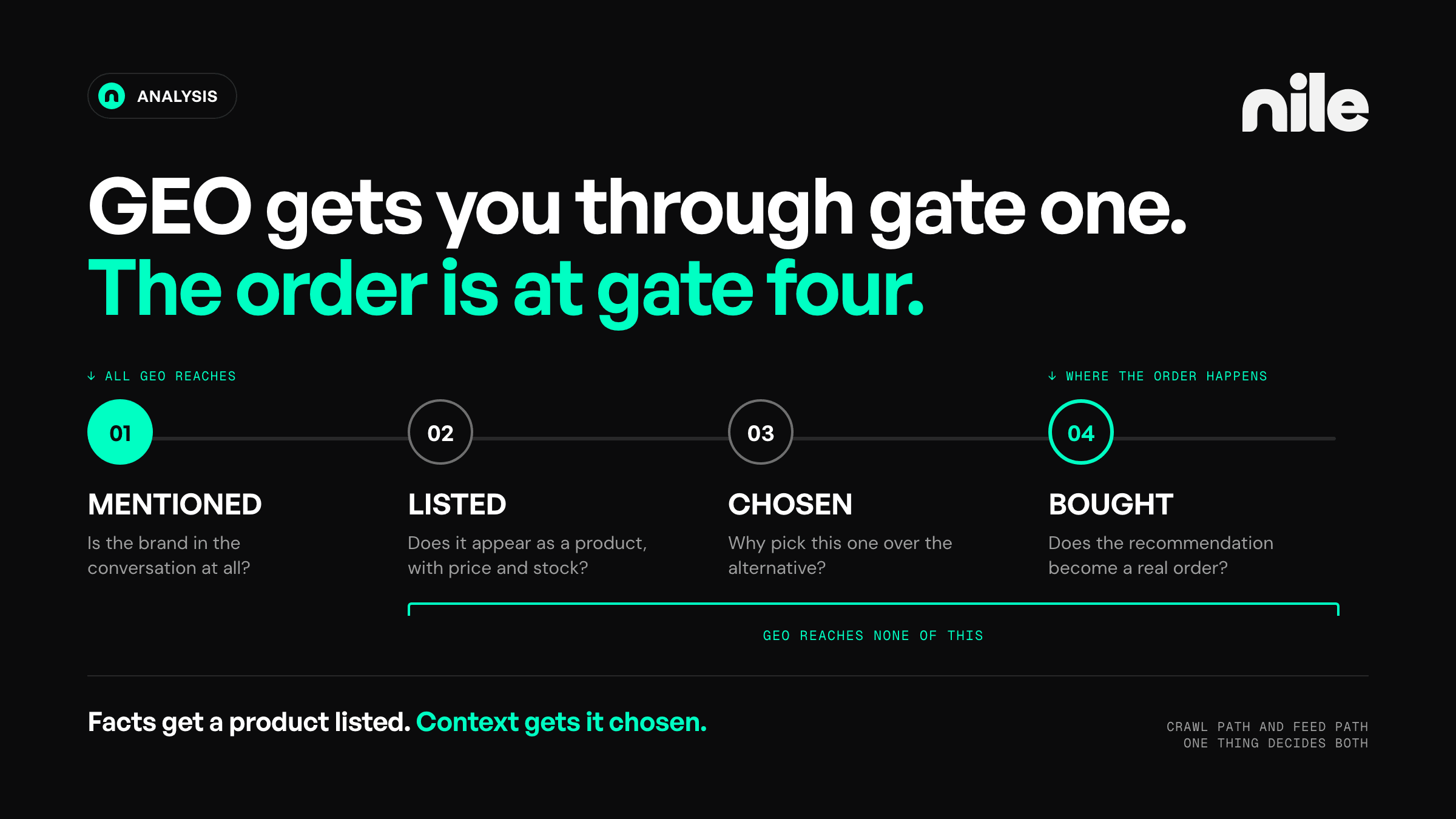
- A broad question is answered mostly from what an engine reads off the open web, the crawl path.
- A precise buying question leans on the structured product records your platform sends, the feed path.
- They fail for different reasons and get fixed by different people.
- Ask an AI assistant a broad question, then a precise one. Two questions, five minutes, and the answer tells you which path is broken.
- Broad first, the kind a shopper uses before they know what they want. That answer comes off the crawl path, so it tells you whether you are described correctly on pages you do not own.
- Then the precise kind that should return an actual product, with a constraint and a price ceiling. That one leans on the feed path.
- Coming back absent, or with the wrong variant or a stale price, is rarely a ranking problem. It is your product records failing to answer a constraint, and authority on the open web does not fix that.
- Measure where you appear rather than blocking the crawler. Leave the robots file alone. Two reports tell you where you are showing up, and which one you want depends on which path you are asking about.
- The generative AI performance report Google shipped alongside the opt-out control covers your pages, giving impressions from AI features by page, country, and device. It went out to a subset in June and to every site worldwide on 31 August 2026, so it should be in your property now.
- Merchant Center's AI performance report covers your products on the same two features, giving share of voice against the competitors you name.
- Neither reports clicks, click-through rate, or the queries involved, so read both as visibility measures and not as performance ones.
The clicks that left were the ones that only ever needed an answer. Your buying moment has moved less than the headline suggests. Where it has moved, it is now settled inside a recommendation rather than on a results page, and a recommendation does not answer to ranking. It answers to whether the facts about your products are complete enough for an AI assistant to make your case for you.
If you want to see what an AI assistant can currently say about your catalog, connecting it to Nile takes a few minutes and costs nothing until it earns you a sale.
Frequently asked questions
Is this a Google penalty?
No. A penalty moves your position and takes your impressions with it. This pattern leaves position and impressions roughly intact while clicks fall, because the reader got their answer above your listing and did not need to click. Chart clicks against impressions in Search Console: if they diverge, it is not a penalty.
Can I opt out of AI Overviews, and should I?
You can, and almost certainly should not. Since June 2026 Search Console has carried a search generative AI control that removes your content from AI Overviews, AI Mode, and generative features in Discover, and Google states it is not used as a ranking or inclusion signal elsewhere in Search. It is a clean switch with no collateral damage. It is also, in Google's own words, a choice to receive no traffic or impressions from those features, while the AI answer continues to appear and resolve the query without you. Two older levers are often mistaken for this one: Google-Extended governs training and grounding in Google's other AI systems and never affected AI Overviews, and the snippet directives do suppress AI features but strip your ordinary search snippet at the same time.
Is ecommerce hit harder than other sectors?
Not at the buying moment, so far. AI Overview presence sits around 8% on commercial searches and 5% on transactional ones, against 36% on informational ones. The exposure inside a store is concentrated in guides and comparison content. Commercial-intent presence did grow 71% between November 2025 and April 2026, so the direction of travel is up the funnel toward research.
Is this the same thing as zero-click search?
An AI Overview is one cause of a zero-click search, not the whole of it. A zero-click search is any search where the reader gets what they came for without visiting a site, which also covers featured snippets, the local pack, and Google's own properties. SparkToro put the United States rate at 68.01% in the first four months of 2026, up from 60.45% in 2024. AI Overviews are the fastest-growing part of that, and the part that most affects informational pages.
How do I quantify what this cost me?
Segment Search Console queries by intent and compare click-through rate change between informational and transactional buckets over the same window, rather than reading a single store-wide average. Hold impressions constant in the comparison. A store-wide click-through number mixes two populations that are moving at very different speeds and will mislead you about where to spend. Keep the brand bucket out of the netting as well. Brand searches can rise while informational ones fall, because someone who meets you inside an AI answer may search your name later rather than click, and averaging the two hides both movements.
How much of my store is actually exposed to this?
Less than the headline implies for most stores, and far more for a few. Exposure tracks how much of your Google traffic arrives on guides and comparison content rather than on product pages. Across a sample of roughly 100 Shopify stores in the 90 days to mid-September 2026, the median store took about a tenth of its Google organic landing traffic on guide and blog pages and about a third on product pages. Four in ten took under 5% on guides, and one in six took more than half. Those are current shares rather than a measurement of anything lost, because they show where traffic lands now and not where it landed before AI Overviews. Check your own split before you plan any work, because it decides the size of the problem.
Do AI Overviews show products, or only text?
Both, on shopping questions. The products in an AI Overview come from Google's Shopping Graph, which your Merchant Center feed populates, so your place in that part of the answer does not depend on your page ranking or on Google crawling your product page. Google reports it separately: Merchant Center's AI performance report covers conversational shopping queries on AI Mode and AI Overviews, limited to organic AI traffic rather than ads. If you are absent there, the fix is in your product data, not in your content.
If citation recovers most of the loss, is being cited enough?
It is the largest lever available and it is not a full recovery. Being cited in an AI Overview returns 120% more organic clicks per impression than being present but uncited, and still lands 38% below the same query with no AI Overview at all. Treat citation as the goal and the shortfall as structural.
Sources
- AI Overviews Reduce Clicks by 58% (update). Ahrefs, published 2026-05-18
- In 2026, Less than One Third of Google Searches Still Send a Click. Rand Fishkin, SparkToro, 2026-06-09
- AIO Impact on Google CTR: 2026 Update. Tracy McDonald, Hannah Cooley, and Marketa Williams, Seer Interactive, 2026-04-24
- AI Overviews Are Expanding Across Commercial Intent Search. Semrush, 2026-07-02
- AI Features and Your Website. Google Search Central documentation, retrieved 2026-08-26
- Search generative AI control. Google Search Console Help, retrieved 2026-08-26
- Introducing Search Generative AI performance reports in Search Console. Google Search Central blog, 2026-06
- About AI performance insights. Google Merchant Center Help, retrieved 2026-09-22
- Nile first-party landing-page data, a sample of roughly 100 Shopify stores with enough Google traffic to measure, 90 days to mid-September 2026. Query text and full results kept at nile-content/research/google-landing-mix-2026-09