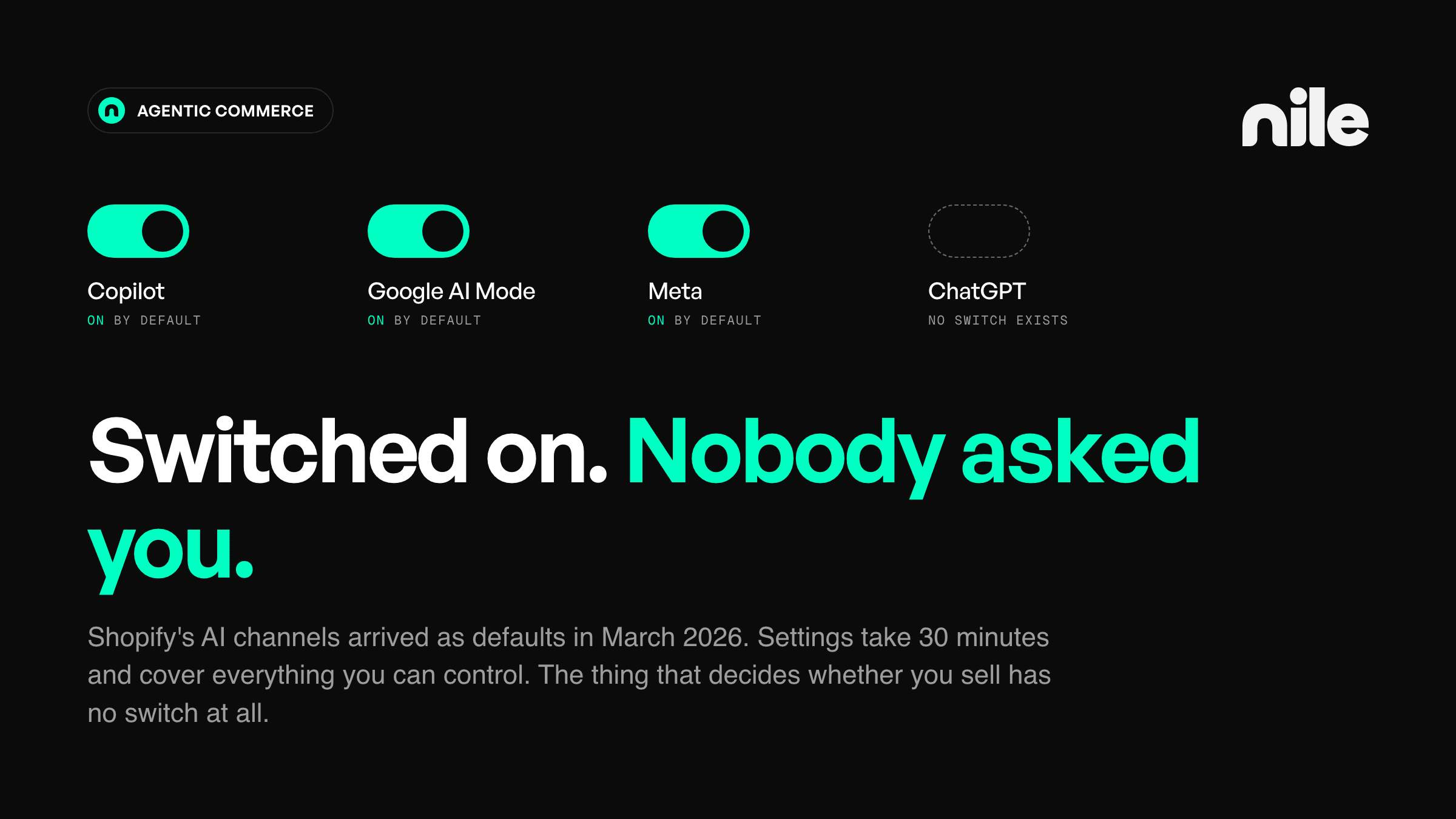

Agentic commerce does not begin at checkout.
The visible interface may be a product card, an AI shopping assistant, a conversational storefront, or an agentic checkout flow. But the work begins much earlier, inside your product data, operational systems, content workflows, and measurement stack.
Adding a chatbot to your website does not make your brand ready. Your products need to be legible to AI systems: data, context, distribution, attribution, and feedback loops prepared for a market where AI systems increasingly influence discovery and decision-making.
1. It starts with product understanding
In traditional e-commerce, the product page is the main unit of persuasion. A shopper lands, reads the copy, views images, checks reviews, decides.
In agentic commerce, the first evaluation happens before the page view. An AI system compares multiple products across price, availability, fit, policy, reviews, merchant reliability, and user preferences. If your product data is incomplete or unclear, the product never enters the recommendation set.
Start by asking whether your product information answers the questions an agent needs to resolve: What is the product? Who is it for? What use case does it serve? What constraints does it satisfy? What should it not be recommended for? How quickly can it arrive? What happens on a return?
These are basic questions for any operator. They are rarely encoded clearly in merchant systems.
2. Product data readiness
Most brands already maintain some structured product data, but quality varies widely. Fields go missing. Variants are inconsistent. Images carry information never captured in text. Descriptions are written for human persuasion, not machine interpretation.
Readiness means accurate attributes, variant-level information, image metadata, availability, price, shipping, returns, warranty, compatibility, ingredients or materials, and category logic. Existing standards still matter: the Google Merchant Center product data specification remains an important reference point for structured commerce data. What agents actually see shows how quickly stale fields turn into wrong answers.
But agentic commerce requires more than compliance. It requires context.
3. Context readiness
A product is not only a product. It is an answer to a situation.
A moisturizer can answer sensitive skin, winter dryness, fragrance-free routines, travel, post-treatment recovery, or minimalist skincare. A protein snack can answer office snacking, post-workout recovery, low-sugar diets, school lunches, or travel. Each context changes how the product should be represented.
This is where static catalog thinking breaks. Connect your products to use cases, audiences, intents, constraints, and performance history. That does not mean generating endless vague content. It means building a structured understanding of where each product is relevant and where it is not. Agentic commerce rewards products that match real user context.
4. Distribution readiness
Once products are structured and contextualized, they need to move into the right channels.
Agentic commerce does not live in one place. It appears across AI search, shopping assistants, product cards, dynamic ads, marketplace agents, conversational storefronts, payment apps, and external protocols. The protocol landscape is forming quickly, and the platform map tracks who is building what: OpenAI and Stripe's Agentic Commerce Protocol, Google's Universal Commerce Protocol, and Visa's Intelligent Commerce all point toward a more distributed agentic commerce environment.
Distribution readiness is not exporting a product feed. It is preparing product context for multiple AI-mediated surfaces.
5. Attribution readiness
You already work with imperfect attribution: last-click models undercount upper-funnel influence, platform reporting conflicts, privacy changes made cross-channel measurement harder. Agentic commerce adds complexity on top.
A user may discover a product in an AI answer, compare it in a conversational flow, click a product card, return later through search, and buy on your site. Or the purchase happens through an agentic checkout protocol or a paid dynamic product ad.
Separate paid external channels, owned AI-native channels, organic protocol traffic, conversational product interactions, product card impressions, and agent-assisted checkout flows. Exact models vary by channel. The point is to track these surfaces distinctly instead of burying them in generic referral traffic.
6. Feedback readiness
Agentic commerce is not a one-time publishing exercise. It is a learning loop.
Track which products get selected, which contexts convert, which product cards perform, which channels bring high-quality traffic, which creative angles fatigue, and which agentic surfaces produce profitable customers. This is the operational bridge between product context and revenue.
It is the loop Nile runs on behalf of its merchants: product, market, advertising, performance, and allocation signals come in; listing and distribution decisions go out; performance feeds the next cycle. Prepare for that direction even if you start with simpler workflows.
7. Where Nile fits
Nile builds your brand agent: your brand, represented on every AI. You connect your catalog once, Nile turns it into an agent-ready representation of your products, and orders flow through your existing setup. No setup fee, no ad spend: you pay only when you sell.
The readiness work above is not busywork. It is exactly what your brand agent runs on: the cleaner your product data and context, the better your brand performs everywhere agents operate.
8. Conclusion
Agentic commerce is not a single feature you turn on. It is a readiness curve, and the brands furthest along it hold clean product data, rich product context, flexible distribution, clear attribution, and closed-loop learning.
Where to start:
- Run the agent test on your top products: can your data answer who it is for, what it should not be recommended for, and what happens on a return?
- Fix product data first: attributes, variants, availability, returns, category logic.
- Map each product to the contexts it answers, and the ones it does not.
- Split agentic surfaces out of generic referral traffic in your analytics now, before volume arrives. Set the ROI baselines at the same time.
- Close the loop monthly: which products get selected, which contexts convert, and feed that back into your catalog.
- Get your brand represented early. Nile onboards selected merchants with no ad spend and no setup fee; you pay only when you sell.
That work starts before checkout. It starts with the product itself.