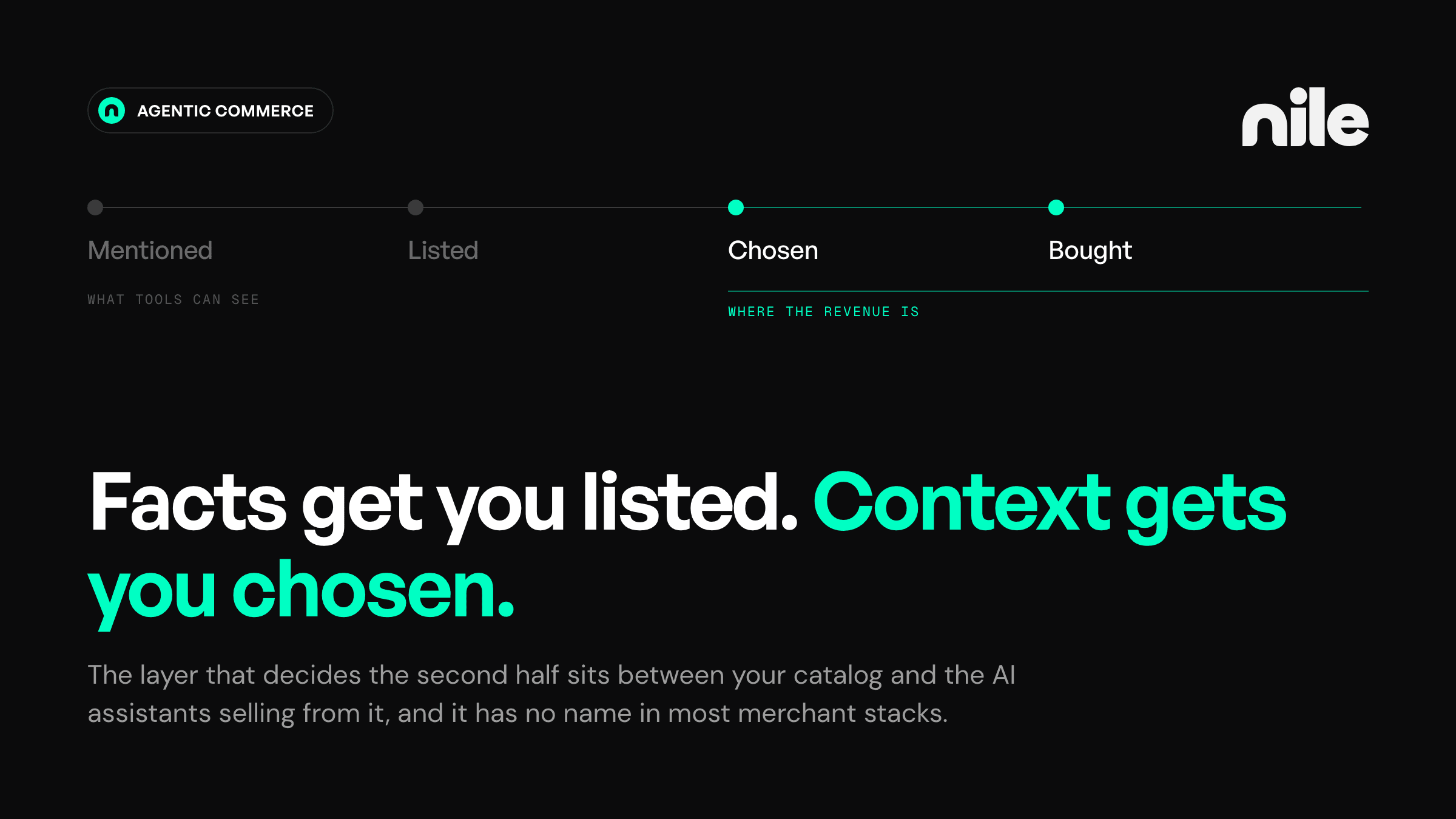

A PDP (product detail page) gives one answer per product. AI answer engines like ChatGPT, Gemini, and Perplexity ask many questions about that product, and each question depends on different facts. Personal agents like Meta's Muse and Instinct go further and buy without the shopper ever visiting your PDP. Winning those questions takes AI briefs: structured records of the same product, one per shopping intent, each carrying the facts that intent depends on.
In the catalogs we have processed at Nile, the basics (name, price, images) are nearly always complete, but the facts a specific shopping intent depends on are present for fewer than half the products. That gap sits in the product data, so adding copy to the PDP does not close it.
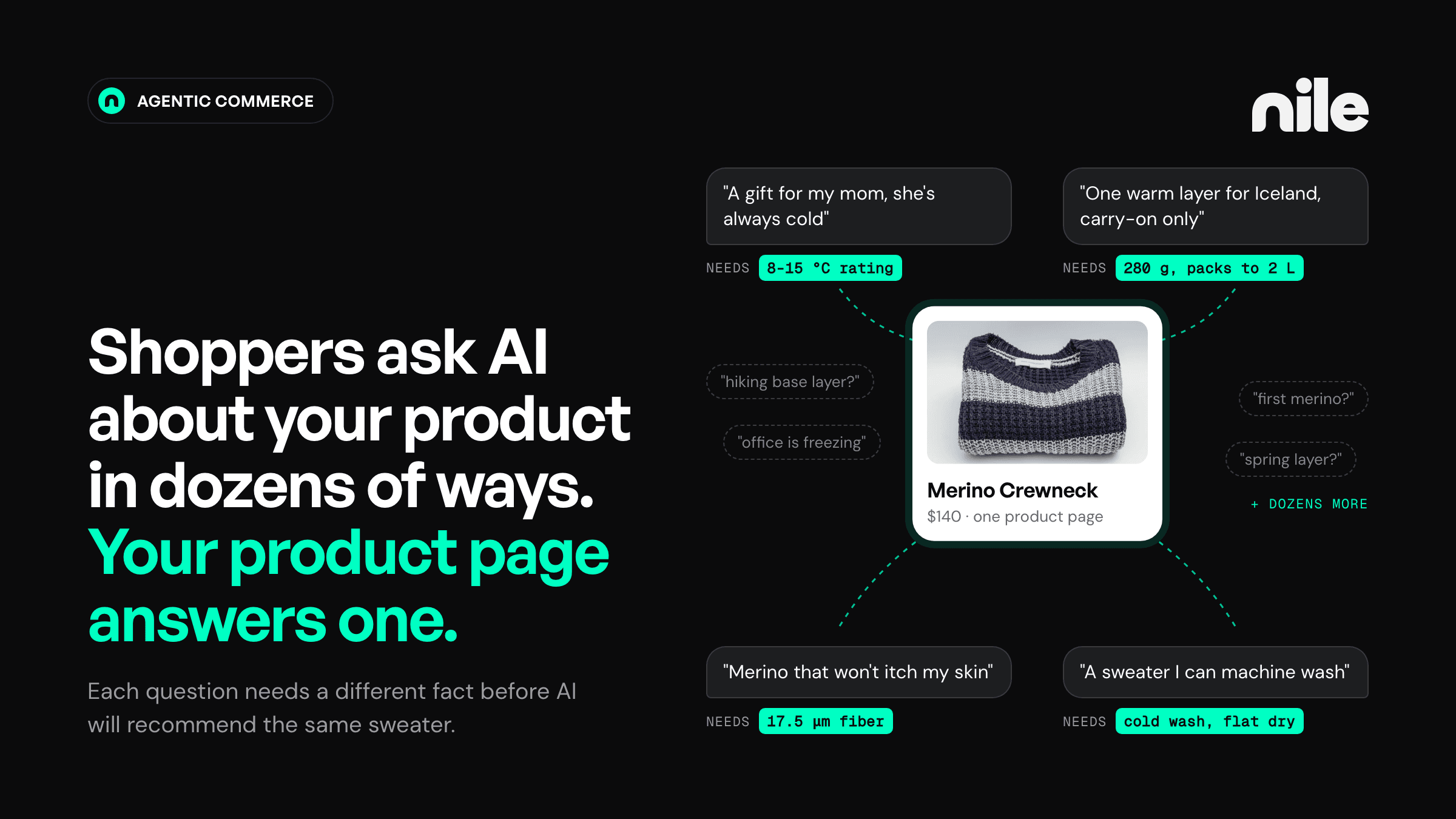
The problem in practice: four shoppers want the same sweater and none of them asks for a sweater. One asks ChatGPT for a gift for someone who is always cold. One asks Perplexity for a single warm layer that will fit in a carry-on for Iceland in October. One asks Gemini for merino that will not itch on sensitive skin. The fourth never searches at all, and tells a personal agent like Meta's Muse to find a machine-washable merino sweater under $150 and buy it. The PDP is the correct answer to all four and written to answer none of them, because it was written to describe a sweater.
The five things your product pages are missing are still worth adding, but even with all of them the page gives one answer, and AI answer engines and personal agents need one for each question a shopper can ask.
The product page is built for browsing
A good product page does a specific job well. It sells to someone who is already looking at it. Hero image, price, the emotional line, the fit note, the reviews, the add-to-cart. Every element assumes a person who is already interested and needs a push to buy.
That page is a destination. It answers "tell me about this product" thoroughly and answers "which product should I get for this situation" only by accident, when the situation happens to match the one the copy imagined.
For 15 years that was fine, because the matching step happened somewhere else. The shopper did it, on a search results page or a collection page, by scanning and eliminating. Your page only had to win once the shopper had already put it on their shortlist.
Matching has now moved off the shopper and into ChatGPT, Gemini, and Perplexity, and increasingly into personal agents like Meta's Muse and Instinct. All of them do that work against your product data, not against your page design.
What AI checks before it recommends or buys your product
Take the second shopper: one warm layer, carry-on only, Iceland, October.
That breaks down into requirements. Warmth for a given temperature range. Packs small, so weight and how far it squashes down. Probably some rain resistance, or at least staying warm when damp. One layer, so it has to work on its own. And a price range the shopper never said out loud.
Now look at what a typical PDP offers against that list: fabric content usually, weight sometimes, care instructions often. A warmth rating and packed volume almost never appear, and whether it stays warm when damp essentially never does, unless a reviewer happened to mention it.
The page is well written for its original purpose. Its claims are there to make you want the sweater, and the AI is looking for claims it can check against the shopper's requirements. A personal agent runs the same check and then goes one step further, because it buys. Nobody reads the PDP in between to fill in what the data left out.
The platforms say as much in their own documentation. OpenAI's commerce docs, updated mid-2026, separate required feed fields, the ones needed to display a product correctly such as identifier, price, and availability, from recommended attributes such as media, reviews, and performance signals, which they say improve ranking and relevance. Display and relevance are different jobs, and most catalogs are complete on the first and thin on the second.
One product, many AI briefs
So describe the product more than once, as AI briefs matched to different shopping intents.
An AI brief is a structured record for the same item, written for the AI rather than for the shopper. Each one leads with the facts, the proof, and the limits that matter for one shopping intent. Price, inventory, and product ID stay the same across all of them. Only what the answer leads with changes.
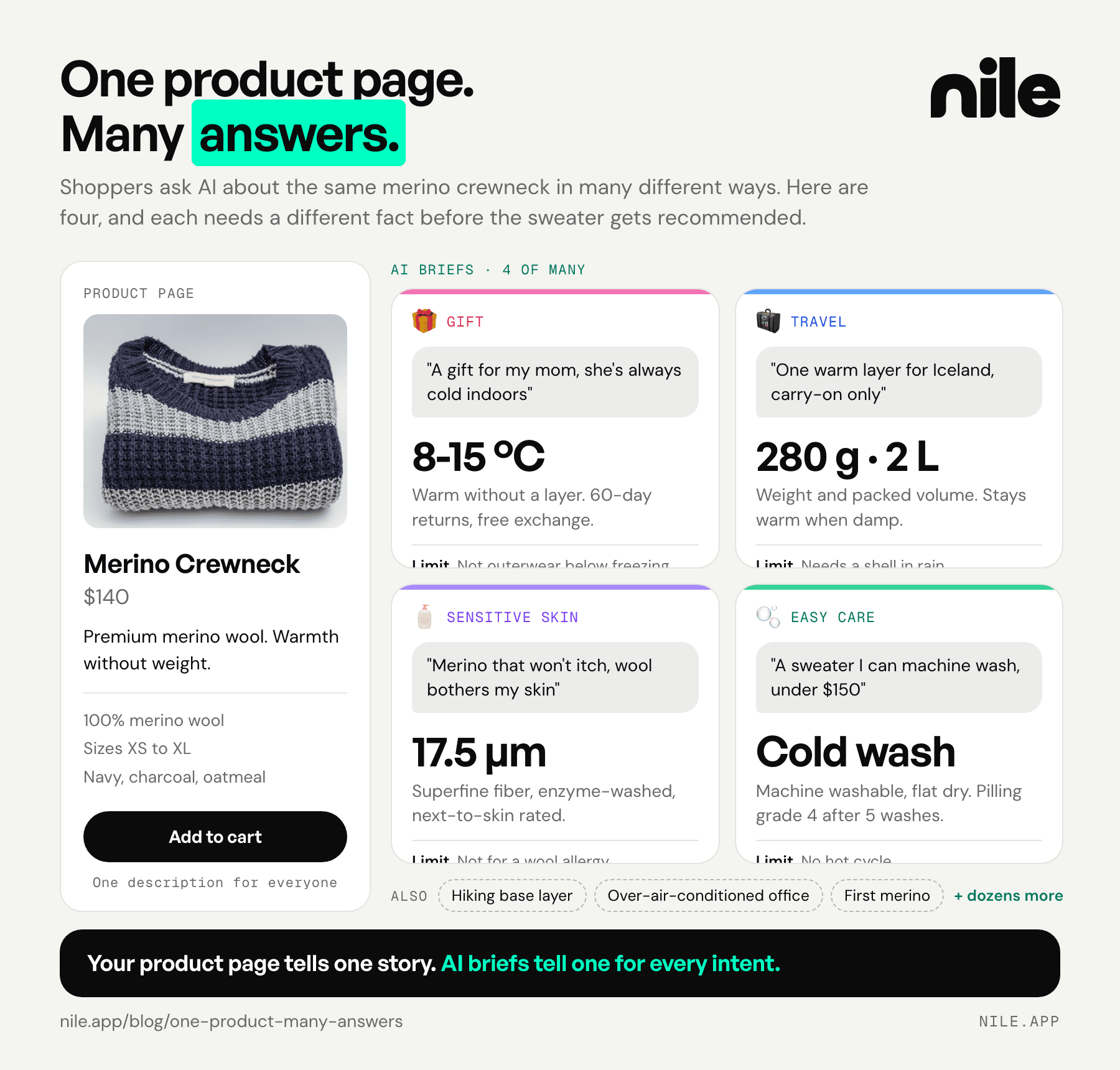
The same $140 merino crewneck is the right answer to many different questions. Here are four of them, each leading with different facts. These are examples, not a template, and far from a complete list:
Gift for someone who runs cold. Leads with warmth in everyday terms, the fact that it works over a shirt without bulk, size guidance that works when you are buying for someone else, and a returns window that makes gifting low risk. Evidence: reviews that mention warmth, and how often buyers swap sizes instead of returning it. Boundary: not a substitute for outerwear below freezing.
One warm layer, carry-on, October. Leads with weight in grams, packed volume, whether it springs back after being squashed in a bag, and warmth when damp. Evidence: a fabric weight specification, reviews from travelers. Boundary: not waterproof, needs a shell in sustained rain.
Merino that will not itch. Leads with fiber thickness in microns, how it is knitted, whether it is treated, and whether it is rated for wearing next to skin. Evidence: the micron specification, what reviews say about itching, and honesty about how many people still find any wool uncomfortable. Boundary: not for anyone with a diagnosed wool allergy.
Merino under $150 that survives machine washing. Leads with care instructions, wash test results if any, and expected pilling. Evidence: care specification and long-term reviews. Boundary: cold wash and flat dry, and it will not tolerate a hot cycle.
One SKU, four honest answers, and four is only a sample. The same crewneck could also answer a hiking base layer, a sweater for an over-air-conditioned office, or a first merino purchase for someone who has only owned cotton. Each brief contains something the product page does not: a number where the page has an adjective, and a plain statement of who the product is not for.
An AI answer engine or personal agent asked to find a sweater for someone with a diagnosed wool allergy should not recommend or buy this product, and a brief that says so protects you from a sale that ends in a return and a bad review. Saying who a product is not for makes the AI trust you more for the shoppers it does fit.
What goes into a brief, and what a brief is not
A brief carries the full product context for one intent: who the product is for, what situation it solves, the measurable points it will be compared on, how it stacks up against alternatives, the proof behind each claim, its limits, and how well it fits each market. Some facts never change between briefs: price, availability, and which product it is. Those have to match in every brief so nothing contradicts.
Most of this context already exists somewhere, just not in one place. Much of it sits inside your business:
- Your product catalog holds titles, descriptions, attributes, and inventory.
- Specification sheets and ingredient lists hold the numbers.
- Customer reviews and Q&A contain the real use cases.
- Support tickets reveal the limitations and the questions people ask before they buy.
- Sales conversations show the objections and what finally gets someone to buy.
- Return reasons tell you where the product stops being the right answer.
- Your brand guidelines and product team know the story, the values, and how the product compares, even if nobody wrote that down.
The rest sits outside it:
- Reviews and threads on Reddit, forums, and marketplaces.
- Creator videos and posts that show the product in real use.
- Press and editorial coverage.
- The comparisons shoppers already make against competing products.
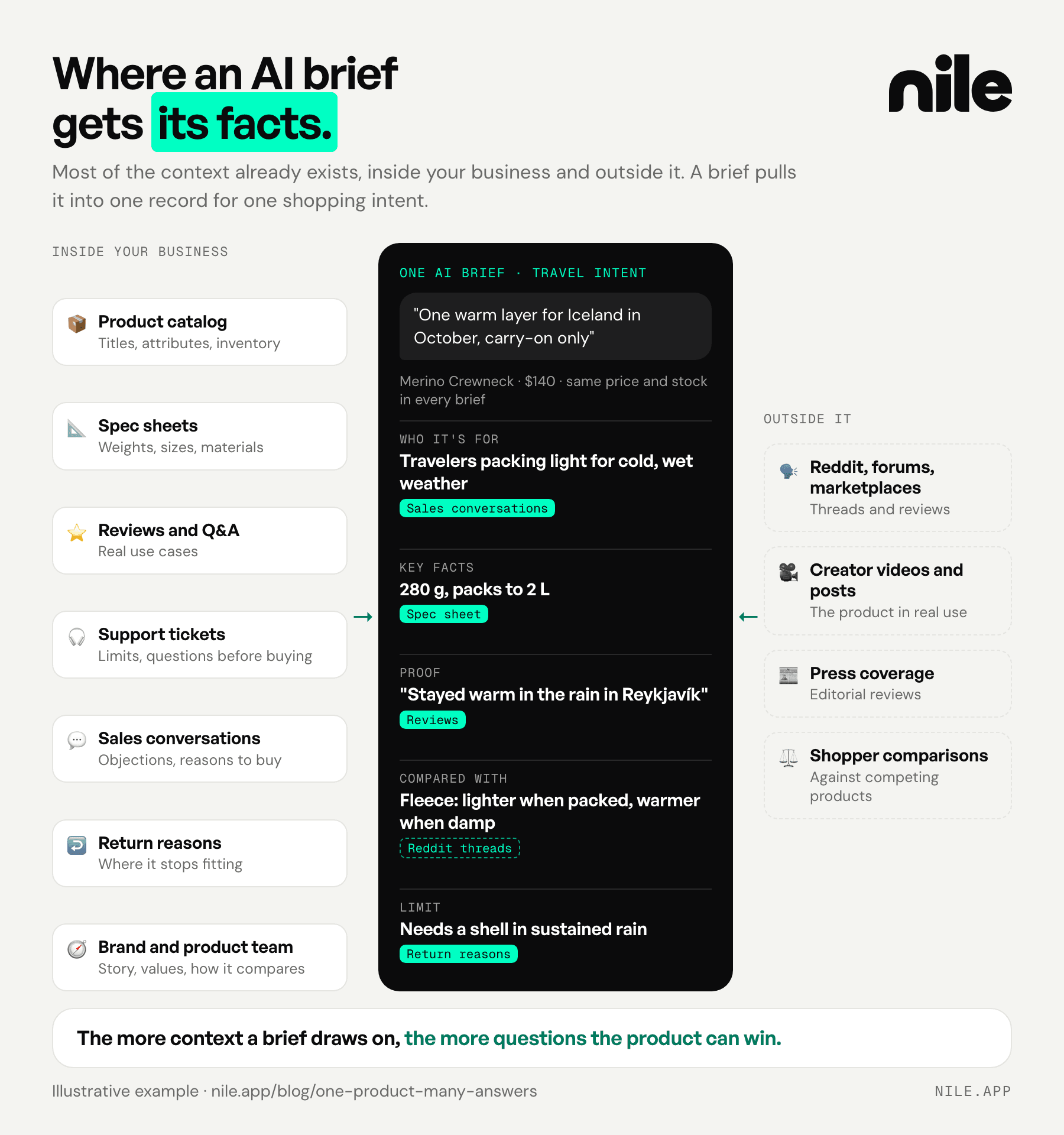
A brief pulls all of it into one record, structured for the way AI matches and compares products. The more of that context a brief draws on, the more questions the product can win.
Briefs live as data records, not as pages competing for search rankings. Publishing a near-identical page for every intent is the old playbook applied to a new problem and would go badly.
Every claim in a brief has to be checkable, which works in your favor when the claims are real and against you when they are not. If you can swap your brand name for a competitor's and the brief still reads as true, the brief says nothing useful and will lose every comparison it enters.
Writing briefs also forces you to find out what your catalog does not know. Most brands discover, doing this, that they cannot state their own fabric weight in a field software can read, or that nobody recorded whether the item can be machine washed, or that the packed volume is absent because no one expected a data field to carry a physical measurement. Nobody noticed while a person did the matching and filled in the blanks. Software that has to compare numbers notices right away. You can see these gaps for your own catalog by connecting it to Nile.
How this differs from SEO, GEO, and feed optimization
SEO aims at clicks. AI briefs aim at recommendations.
SEO aims a page at a query so a person clicks the page. The result is a ranked list, and you win when someone clicks.
Intent-matched AI briefs aim a structured record at a shopping intent so ChatGPT, Perplexity, or a personal agent can match, compare, and recommend without a click happening at all. The result is a shortlist of two or three products with reasons attached, and you win by making the list.
You can hold position one on "merino crewneck" and still be absent from every recommendation for "warm layer that packs small," because those recommendations are built from product facts, and page rankings do not come into it.
GEO and AEO get you mentioned, not chosen.
Generative engine optimization (GEO) and answer engine optimization (AEO) solve the first problem: making sure AI answer engines can find and quote your brand and content. They work, and they are worth doing. Their limit is the subject of a separate piece, GEO gets you mentioned, not bought.
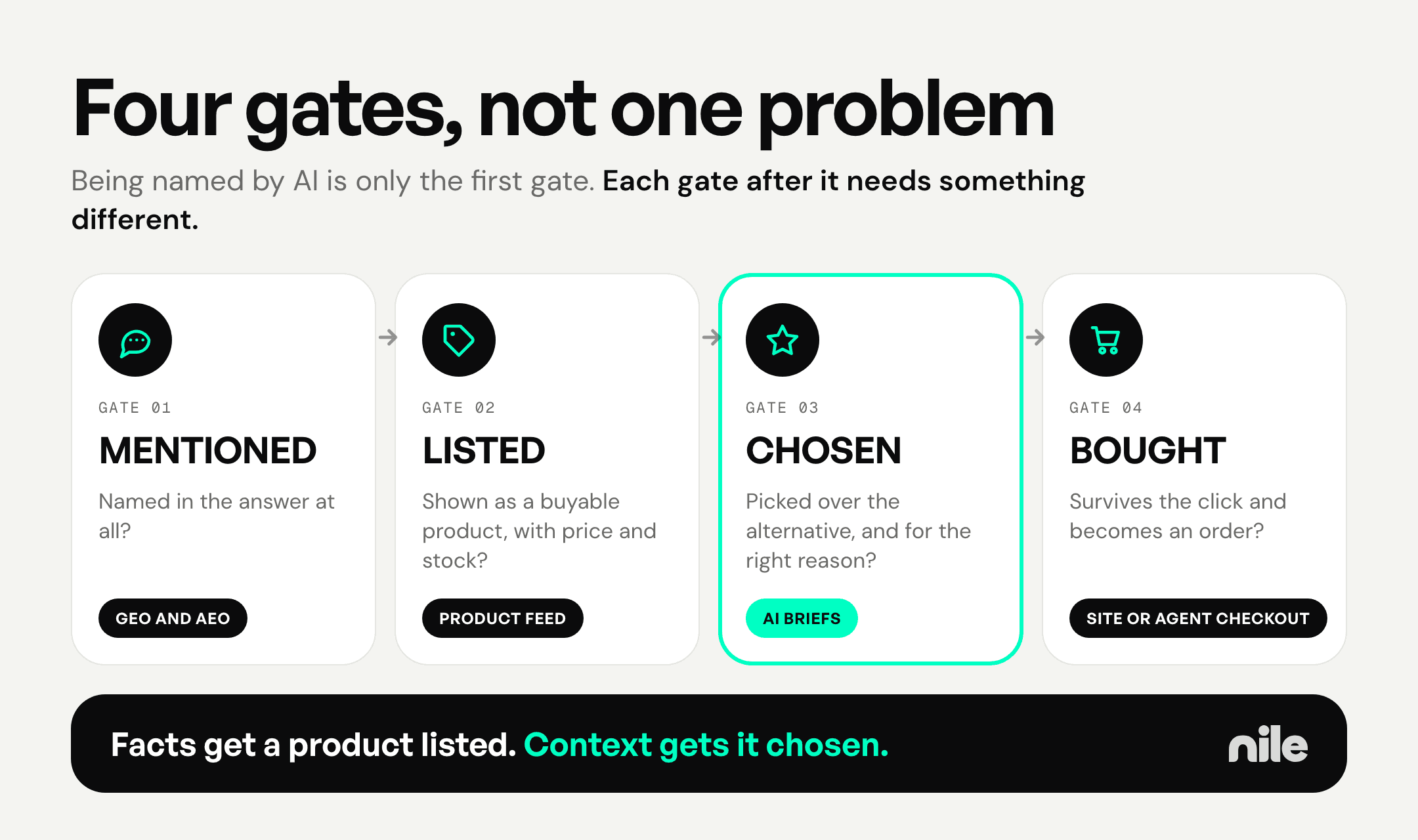
Where they stop is the product shortlist. GEO makes content visible. It does not supply the product facts, proof, and points of comparison that decide which product wins when an AI is choosing between three options. A brand can be excellent at GEO and still lose every recommendation on a missing size chart.
Related tools solve related problems.
Schema markup labels existing facts on a page. Feed optimization tools complete the required product feed fields. Channel management platforms send the feed out to shopping channels. None of them writes one product up for many different shopping intents, because that was never their job. AI briefs are a different kind of content, built for the way AI picks products.
The scale problem: why this cannot stay manual.
Each product can match dozens of different shopping intents, and each intent calls for different facts and proof. Multiply that across hundreds or thousands of SKUs and the number of briefs grows very quickly. The closest analogy is the shift from manual media buying to programmatic: you can write AI briefs by hand for your top 10 to 20 products, but doing it across a full catalog, keeping the context current as products and markets change, and improving them based on what sells is more than a spreadsheet can carry.
What you gain: more recommendations, better-fit buyers, sales without a page visit
The work moves earlier in the process, into material no shopper reads but that decides whether a shopper ever shows up. The payoff shows up in numbers you already track.
More questions your product can win. Every brief is one more shopping question your product can be the answer to. A PDP competes for the few queries its copy happens to fit. A catalog written up as briefs competes for the long tail of niche questions nobody would ever build a landing page for.
Shoppers who arrive already convinced. A shopper who clicks through from an AI recommendation has had the matching done for them, so the PDP only has to confirm the reason they came. If the brief said 280 grams and the page implies a heavy winter sweater, you have introduced doubt at the last possible moment.
The landing experience should carry the intent forward instead. When a shopper arrives from a recommendation about "warm layer for Iceland," the page they reach should lead with warmth and how small it packs, not the generic hero shot and "premium merino wool" headline. Think of it as the intent-matched equivalent of dynamic keyword insertion in paid search: same product, different framing, matched to the reason the shopper showed up.
Traffic that arrives this way converts differently. At one health hardware merchant we work with, visits from AI shopping channels became orders at about twice the rate of site-wide visits over a few weeks in mid-2026, and the site itself had not changed, only the catalog behind it. That is one account, measured on last-click attribution in a before-and-after comparison on the same store, so read it as evidence about traffic quality rather than proof of cause.
Fewer wrong-fit orders. A brief that states where the product stops being the right answer keeps it out of recommendations that end in a return and a bad review. The shopper with a wool allergy never gets sent to the merino crewneck, and the reviews the product does collect come from people it suited.
Sales without a page visit. Personal shopping agents are already completing purchases without the buyer ever visiting a PDP. Meta's Muse, which launched in September 2026, checks out through Stripe's Link once the shopper approves the total, and Instinct users have had it buy their weekly groceries and concert tickets, according to its founder. In that flow, the agent picks the product and checks out using only your product data, and no product page gets a chance to change its mind. The briefs are the only sales material that reaches that buyer.
Where to start
- Pick the 10 to 20 products that matter most to revenue.
- List the intents shoppers bring to them. Reviews, support tickets, and return reasons already contain most of them.
- For each intent, check whether your catalog can state the fact that intent depends on, as a number or a plain yes or no. Every gap is a question your product currently cannot win.
Doing that by hand works for 10 or 20 products. Nile builds this layer for brands: turning an existing catalog into intent-matched AI briefs, sending them to AI shopping channels, and tracking what happens from recommendation to purchase. The catalog stays where it is. The store, checkout, customers, and fulfillment stay yours.
If you want to see what your catalog can and cannot currently answer, connecting it to Nile takes a few minutes and costs nothing until it earns you a sale.
AI briefs are one component of a larger idea: the layer that sits between your catalog and the AI that sells from it.
Frequently asked questions
Is this just structured data or schema markup?
Schema markup is a vocabulary for labeling facts on a page, and it is one way part of a brief can be expressed. It does not decide which facts a given intent depends on, and it cannot supply facts your catalog never captured, like fabric weight or whether the item survives a machine wash. The hard part is deciding what to say and having the underlying facts, not the labeling format.
Do I build these as real pages, or as data?
As data. Briefs are structured records for AI matching, not landing pages for search rankings. Publishing a near-identical page for every intent is the old playbook applied to a new problem and it creates the duplicate content situation people rightly worry about.
Will this dilute my search optimization?
Not if the briefs stay as data rather than becoming pages. Briefs work in a different place, where products are matched on their facts rather than ranked by page. If anything the exercise strengthens your pages, because filling in the attributes your briefs need usually means adding specifics your product pages were missing too.
How many briefs does a product need?
As many as it has genuinely different intents it can honestly serve. For a simple, single-purpose product that may be a handful. For a versatile one it can run to dozens once you count use cases, recipients, climates, markets, and limits like budget or care. The test is whether the shopper's requirements change what you would lead with and where the limits sit. If two briefs say the same things in a different order, it is one brief.
What if my catalog does not have the attributes these briefs need?
That is the common finding, and it is the useful part of the exercise. Most brands cannot state their own fabric weight, packed volume, or care tolerance in a form software can read. Those gaps did little harm while a person did the matching and filled in the blanks. They cost you the sale when software has to compare numbers.
Sources
- Agentic Commerce: key concepts — OpenAI Developers documentation (accessed 2026-08-26)
- Meta built an AI that can shop for you. The problem is that most people don't want AI spending their money — Fortune (accessed 2026-09-28)
- Viral AI startup Instinct has raised $350M at a $2.5B valuation — TechCrunch (accessed 2026-09-28)